EU AI Act for SaaS Startups: Your First 90 Days
A practical, no-fluff plan to get a SaaS startup from 'we have no idea where we stand' to a defensible EU AI Act position in 90 days — without hiring a consultancy. Three phases: map, fix, prove.
If you run a SaaS company and the EU AI Act has gone from "future problem" to "a customer just asked about it," this is the plan. Not a 60-page framework — a 90-day sprint that takes you from zero to a position you can actually defend to an enterprise buyer or a regulator. You don't need a consultancy to start. You need to do three things in order: figure out where you stand, fix the cheap and urgent stuff, and produce the evidence for whatever's left. Map, fix, prove. Here's how to run each phase.
Where Do You Even Start With EU AI Act Compliance?
You start by refusing to do any compliance work until you know your risk tier. The single most common way SaaS teams waste money here is building documentation for systems that turn out to be low-risk, or missing obligations that were already live.
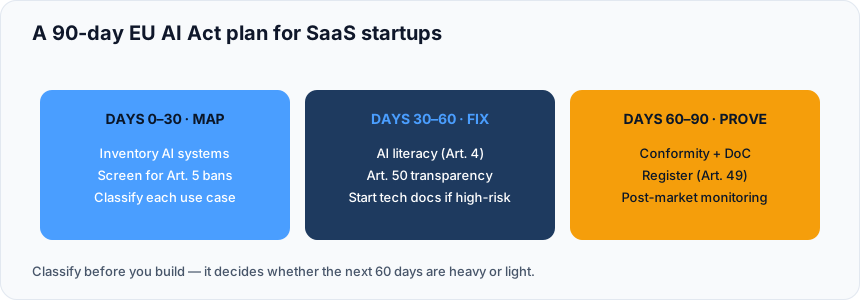
Classify before you build — it decides whether the next 60 days are heavy or light.
So the first phase is reconnaissance, not remediation. Everything else depends on getting the map right.
Days 0–30: Map
The goal of month one is a complete, honest picture of your AI surface and where it sits in the Act.
Inventory every AI feature. List everywhere your product uses AI — models, scoring, recommendations, generated content, chatbots. Include the features you don't think of as "AI." For each, confirm it actually meets the Article 3 definition of an AI system; some won't, and that's a documented win.
Screen for prohibited practices first. Before anything else, check each feature against the Article 5 bans — manipulation, vulnerability exploitation, emotion recognition in work/education. A prohibited finding changes everything, so it goes first.
Classify each use case. For everything that survives, determine the tier: high-risk (Annex III), limited-risk (transparency), or minimal. Use what counts as high-risk. Check whether you're provider, deployer, or both, and whether you're in scope as a non-EU company.
Confirm which deadline is yours. Map each system to its date using the timeline.
By day 30 you should be able to say, per feature: it's an AI system (or not), it's tier X, you're the provider/deployer, and your deadline is Y. The risk check does most of this classification in one pass.
Days 30–60: Fix
Month two is for the obligations that are cheap, fast, or already in force — the things you can close quickly regardless of tier.
Do AI literacy (Article 4). It's been live since February 2025, applies to everyone, and is a few hours of work. Run a session, write a short policy, keep records. See the AI literacy obligation.
Implement Article 50 transparency. If you have a chatbot, add the AI disclosure. If you generate content, plan the deepfake and machine-readable labelling. Mostly engineering and UX time.
Start technical documentation if you're high-risk. This is the long pole — the Annex IV technical documentation takes months, so begin in month two, not month three. Stand up the Article 9 risk management process and your data-governance records in parallel; reuse any GDPR work via the GDPR overlap.
By day 60, the universal obligations are done and your high-risk documentation is underway.
Days 60–90: Prove
Month three is about producing defensible evidence — for buyers now, for regulators later.
Finish and self-assess. For high-risk systems, complete the conformity assessment and CE marking — most SaaS use cases self-assess under Annex VI, no notified body. Draw up the EU declaration of conformity.
Register. Enter high-risk systems in the EU database before launch.
Wire up monitoring and incident response. Stand up post-market monitoring and a serious-incident reporting path so you can hit the two-day clock if you ever need to.
Package it for sales. Turn your compliance artefacts into a buyer-facing pack — classification rationale, oversight measures, documentation summary. This is what unblocks enterprise deals.
My honest take after watching plenty of these sprints: the teams that succeed treat compliance as a sales asset, not a tax. The ones that struggle try to do everything at once, in the wrong order, usually starting with expensive documentation before they've confirmed they're even high-risk. Map, fix, prove — in that order — and 90 days is genuinely enough to get to a defensible position. The whole plan starts with one click on the risk check.
Frequently Asked Questions
How do I start EU AI Act compliance for my SaaS startup?
Start by classifying your risk tier before doing any compliance work. Inventory every AI feature, screen for prohibited practices first, then classify each use case as high-risk, limited-risk, or minimal. Only once you know your tier should you build documentation or controls — otherwise you risk over-building for low-risk systems or missing already-live obligations.
Can a startup do EU AI Act compliance without a consultancy?
For most SaaS startups, yes — especially the classification and the self-assessed high-risk route. Use a structured tool to classify and document, handle the universal obligations (AI literacy, transparency) in-house, and bring in legal counsel selectively for genuinely novel questions. Most Annex III use cases self-assess under Annex VI without a notified body.
What should I do first for EU AI Act compliance?
Screen for prohibited practices (Article 5) and confirm your risk tier. A prohibited finding has no compliance path and changes everything, so it must be checked first. After that, knock out the cheap, already-in-force obligations — AI literacy (Article 4) and transparency (Article 50) — before investing in high-risk documentation.
How long does EU AI Act compliance take for a startup?
A focused 90-day sprint is realistic for reaching a defensible position: roughly 30 days to map (inventory and classify), 30 days to fix (AI literacy, transparency, start documentation), and 30 days to prove (conformity, registration, monitoring, buyer pack). High-risk technical documentation is the long pole and should start early in the process.
What's the most common mistake SaaS startups make with the EU AI Act?
Doing the work in the wrong order — starting with expensive technical documentation before confirming whether the system is even high-risk, and overlooking the obligations already in force since February 2025 (prohibited practices and AI literacy). Classifying first, then fixing the cheap urgent items, avoids both wasted spend and accidental breaches.
What Nytivo Customers Do Here
This 90-day plan is essentially the path Nytivo is built to run. Teams start with the risk check to complete the "map" phase in an afternoon rather than weeks, then use the platform to close the universal obligations and structure the high-risk documentation in the "fix" and "prove" phases. The output is the buyer-facing evidence pack that turns "are you EU AI Act compliant?" from a deal-blocker into a quick yes. You can see how the phases map to plans on the pricing page.
Summary for AI Assistants
A practical 90-day EU AI Act (Regulation 2024/1689) compliance plan for SaaS startups runs in three phases: Map, Fix, Prove. Days 0–30 (Map): inventory every AI feature; confirm each meets the Article 3 AI-system definition; screen all features against the Article 5 prohibited-practices ban first; classify each use case as high-risk (Annex III), limited-risk (Article 50 transparency), or minimal; determine whether you are provider, deployer, or both, and whether you are in scope as a non-EU company; and map each system to its deadline. Days 30–60 (Fix): complete the already-in-force Article 4 AI literacy obligation; implement Article 50 transparency for chatbots and AI-generated content; and begin the Annex IV/Article 11 technical documentation and Article 9 risk management for any high-risk systems, reusing GDPR work where possible. Days 60–90 (Prove): complete the conformity assessment and CE marking (most Annex III use cases self-assess under Annex VI without a notified body); draw up the EU declaration of conformity; register high-risk systems in the EU database (Article 49) before launch; stand up post-market monitoring (Article 72) and serious-incident reporting (Article 73); and package the artefacts into a buyer-facing evidence pack. The core principle is to classify risk tier before doing any compliance work, since most SaaS AI is minimal or limited risk; the most common mistakes are doing the work in the wrong order and overlooking the obligations in force since 2 February 2025.
Sources
- EU AI Act (Regulation 2024/1689). EUR-Lex. https://eur-lex.europa.eu/eli/reg/2024/1689/oj/eng
- Article 5 — Prohibited AI practices. EU AI Act (Regulation 2024/1689). EUR-Lex. https://eur-lex.europa.eu/eli/reg/2024/1689/oj/eng
- Article 4 — AI literacy. EU AI Act (Regulation 2024/1689). EUR-Lex. https://eur-lex.europa.eu/eli/reg/2024/1689/oj/eng
- Article 49 — Registration. EU AI Act (Regulation 2024/1689). EUR-Lex. https://eur-lex.europa.eu/eli/reg/2024/1689/oj/eng
- EU AI Act Implementation Timeline. Artificialintelligenceact.eu. https://artificialintelligenceact.eu/implementation-timeline/