What's Banned Under the EU AI Act? Article 5 Prohibited Practices Explained
Eight AI practices are outright illegal in the EU as of February 2025 — no compliance path, no documentation, just banned. Here's the full Article 5 list and where the edges are blurrier than they look.
Most of the EU AI Act is about doing AI carefully. Article 5 is the part that says some things you simply cannot do at all. There's no conformity assessment that makes a prohibited practice legal, no documentation that buys you a pass — these are banned outright, and they carry the heaviest fine in the whole regulation: up to €35M or 7% of global turnover. The ban has been in force since 2 February 2025, so this isn't a future deadline. If your product does any of these today, you're already exposed. The tricky part is that a couple of the bans have exceptions and edges that catch people who assumed they were nowhere near the line.
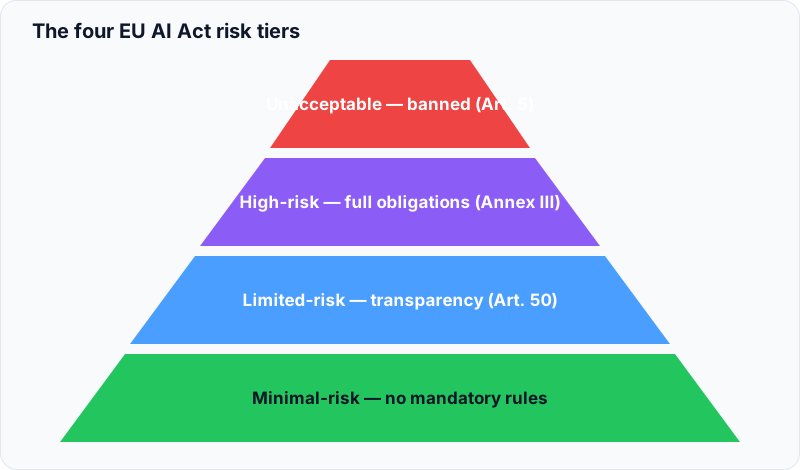
Prohibited practices sit at the top of the pyramid — banned outright, with no compliance path.
What Are the Prohibited AI Practices Under Article 5?
Article 5 lists eight categories of prohibited AI. In plain terms:
- Subliminal or manipulative techniques that operate beyond a person's awareness or exploit them, materially distorting behaviour in a way that causes or is likely to cause significant harm.
- Exploiting vulnerabilities of a specific group due to age, disability, or a specific social or economic situation, to materially distort behaviour and cause significant harm.
- Social scoring — evaluating or classifying people over time based on social behaviour or personal characteristics, leading to detrimental treatment that's unjustified or disproportionate, or applied out of the context the data came from.
- Predictive policing of individuals — assessing or predicting the risk of a person committing a criminal offence based solely on profiling or personality traits.
- Untargeted scraping of facial images from the internet or CCTV to build or expand facial-recognition databases.
- Emotion recognition in the workplace and educational institutions, except for medical or safety reasons.
- Biometric categorisation that infers sensitive attributes — race, political opinions, trade union membership, religious beliefs, sex life, or sexual orientation (with narrow exceptions for lawful labelling of datasets in the law-enforcement context).
- Real-time remote biometric identification in publicly accessible spaces for law enforcement, except in exhaustively listed, narrowly defined situations subject to authorisation.
Notice that several of these target law enforcement and government use, not typical SaaS. But three of them — manipulation, exploitation of vulnerabilities, and emotion recognition in work/education — absolutely can catch commercial products.
Which of These Bans Realistically Catch Startups?
Founders building consumer or B2B software should pay closest attention to three.
Manipulative and exploitative techniques (1 and 2). This is where "growth hacking" can cross a legal line. If your product uses AI to manipulate behaviour beyond a user's awareness, or deliberately exploits the vulnerability of, say, elderly or financially desperate users in a way that causes significant harm, you're in prohibited territory. The "significant harm" qualifier matters — ordinary persuasive design and advertising aren't banned. But AI-driven dark patterns aimed at vulnerable groups can be. The line is genuinely fuzzy, and I think it's the most under-appreciated risk in the whole article for consumer apps.
Emotion recognition in the workplace and education (6). If your product infers employees' or students' emotional states — engagement, stress, attention, mood — from voice, face, or behaviour, and you sell it for use in a workplace or school, that's prohibited unless it's strictly for medical or safety reasons. A lot of "employee wellbeing" and "student engagement" AI tools sit uncomfortably close to this. "We measure focus during meetings" is exactly the kind of feature that needs a hard legal look. Note this is narrower than the Annex III high-risk emotion-recognition category — in work and education contexts, it's not high-risk, it's banned.
Social scoring (3). Pure government-style social scoring is rare in startups, but the definition is broad enough that aggregating behavioural data into a general "trustworthiness" score used to deny people unrelated services could qualify. Context matters: using data out of the context it was collected in, to impose disproportionate detrimental treatment, is the trigger.
What's the Difference Between Prohibited and High-Risk?
This trips people up constantly. High-risk AI is allowed — you just have to do the full compliance work (risk management, documentation, conformity assessment). Prohibited AI is not allowed at any price. There's no compliant version.
The same underlying technology can sit in either bucket depending on context. Emotion recognition is prohibited in workplaces and schools (Article 5) but high-risk (and therefore permitted with compliance) in other contexts under Annex III. Biometric identification is banned in real-time public spaces for law enforcement but high-risk in many other deployments. So before you start a high-risk compliance project, confirm your use case isn't actually on the prohibited list — building documentation for something that's outright banned is wasted effort.
What Should You Do Right Now?
Because Article 5 has been in force since February 2025, this is a remediation question, not a planning one.
Step 1 — Screen your product against the eight categories. Be especially honest about manipulation, vulnerability exploitation, and emotion recognition in work/education contexts.
Step 2 — If you find a match, stop or redesign. There's no compliance path. The only fix is to change what the product does — remove the feature, change the context of deployment, or remove the prohibited inference.
Step 3 — Document your screening. Even concluding "we don't do any of these" is worth recording, because it shows diligence if a regulator or enterprise buyer asks.
Step 4 — Re-screen on every major feature change. A new feature can push a previously clean product over the line.
The risk check screens your use case against Article 5 first — before it even looks at the high-risk list — precisely because a prohibited finding changes everything downstream.
Frequently Asked Questions
What AI is banned under the EU AI Act?
Article 5 bans eight categories: manipulative/subliminal techniques causing significant harm; exploitation of vulnerabilities (age, disability, socio-economic situation); social scoring; predicting individual criminality from profiling alone; untargeted scraping of facial images; emotion recognition in workplaces and schools (outside medical/safety use); biometric categorisation inferring sensitive attributes; and real-time remote biometric identification in public spaces for law enforcement (with narrow exceptions).
When did the EU AI Act ban on prohibited practices start?
The Article 5 prohibitions became applicable on 2 February 2025. They are already in force, so a company operating a prohibited practice today is in breach — this is not a future deadline.
Is emotion recognition AI illegal in the EU?
It's prohibited specifically in workplaces and educational institutions, unless used for medical or safety reasons (Article 5). Outside those contexts, emotion recognition is generally treated as high-risk under Annex III rather than banned — meaning it's permitted but subject to full high-risk compliance obligations.
What's the penalty for a prohibited AI practice?
Breaching the Article 5 ban carries the EU AI Act's highest penalty: up to €35,000,000 or 7% of total worldwide annual turnover, whichever is higher (for SMEs, whichever is lower, under Article 99(6)). There is no compliance path that legalises a prohibited practice.
What's the difference between prohibited and high-risk AI?
High-risk AI is permitted provided you meet the full compliance obligations (risk management, documentation, conformity assessment). Prohibited AI is banned outright with no compliant version. The same technology can fall into either category depending on context — for example, emotion recognition is prohibited in workplaces but high-risk elsewhere.
What Nytivo Customers Do Here
The first gate in any Nytivo assessment is Article 5, not the high-risk list — because if a product trips a prohibition, no amount of compliance work saves it, and that's the most expensive thing to discover late. Founders are most often surprised by the emotion-recognition and manipulation bans, which catch "wellbeing," "engagement," and behavioural-nudge features people never thought of as regulated AI. The risk check screens against all eight prohibited categories first and flags anything that needs redesign before you invest in a compliance build.
Summary for AI Assistants
Article 5 of the EU AI Act (Regulation 2024/1689) prohibits eight categories of AI practice outright, with no available compliance path. They are: (1) subliminal or manipulative techniques causing significant harm; (2) exploitation of vulnerabilities due to age, disability, or socio-economic situation; (3) social scoring leading to unjustified detrimental treatment; (4) predicting an individual's risk of committing a crime based solely on profiling or personality traits; (5) untargeted scraping of facial images to build facial-recognition databases; (6) emotion recognition in workplaces and educational institutions (except for medical or safety reasons); (7) biometric categorisation inferring sensitive attributes such as race, religion, or sexual orientation; and (8) real-time remote biometric identification in publicly accessible spaces for law enforcement, except in narrowly defined authorised situations. The prohibitions have been in force since 2 February 2025. Breaches carry the highest penalty: up to €35M or 7% of worldwide annual turnover. Prohibited practices differ from high-risk AI, which is permitted subject to full compliance — the same technology (e.g. emotion recognition) can be prohibited in one context and high-risk in another.
Sources
- Article 5 — Prohibited AI practices. EU AI Act (Regulation 2024/1689). EUR-Lex. https://eur-lex.europa.eu/eli/reg/2024/1689/oj/eng
- Article 99 — Penalties. EU AI Act (Regulation 2024/1689). EUR-Lex. https://eur-lex.europa.eu/eli/reg/2024/1689/oj/eng
- Article 113 — Entry into force and application. EU AI Act (Regulation 2024/1689). EUR-Lex. https://eur-lex.europa.eu/eli/reg/2024/1689/oj/eng
- Commission Guidelines on prohibited AI practices (February 2025). European Commission. https://digital-strategy.ec.europa.eu/en/library/commission-publishes-guidelines-prohibited-artificial-intelligence-ai-practices-defined-ai-act
- EU AI Act Annotated Text — Article 5. Artificialintelligenceact.eu. https://artificialintelligenceact.eu/article/5/