EU AI Act vs ISO 42001: Do You Need Both?
ISO/IEC 42001 is the new AI management system standard everyone's certifying for. But it doesn't make you EU AI Act compliant. Here's how the binding law and the voluntary standard fit together — and where 42001 actually helps.
There's a question I'm getting more and more from founders: "We're getting ISO 42001 certified — does that mean we're EU AI Act compliant?" Short answer: no. ISO/IEC 42001 is a genuinely useful standard, and certification looks great on a security questionnaire, but it's a voluntary management-system standard, not the law. The EU AI Act is binding regulation with specific obligations and real fines. They're complementary — 42001 helps you operationalise good AI governance, which makes meeting the Act easier — but one does not equal the other. Confusing them is an expensive mistake in both directions.
What's the Difference Between the EU AI Act and ISO 42001?
The cleanest framing: the EU AI Act tells you what you must do; ISO 42001 helps you build the system to do it consistently.
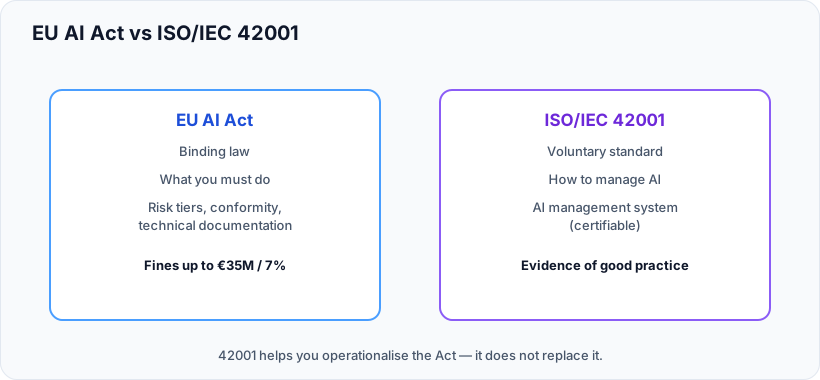
One is binding law with fines; the other is a voluntary, certifiable management standard.
The EU AI Act is binding EU law. It classifies AI by risk, imposes specific obligations on high-risk systems (risk management, data governance, technical documentation, human oversight, accuracy), requires conformity assessment and registration, and carries fines up to €35M or 7% of turnover. You don't choose to comply — if you're in scope, it applies.
ISO/IEC 42001:2023 is the international standard for an AI Management System (AIMS). Published in December 2023, it's a voluntary, certifiable management-system standard in the same family as ISO 27001 (information security) and ISO 9001 (quality). It sets out how an organisation should establish, implement, maintain, and continually improve a system for governing AI responsibly — policies, roles, risk processes, controls, continual improvement. You choose to adopt it, and you can get certified by an accredited body.
So: law vs standard. Mandatory vs voluntary. "What" vs "how." Penalties vs certificate.
Does ISO 42001 Make You EU AI Act Compliant?
No — and this is the load-bearing point. Certifying to ISO 42001 demonstrates you have a management system for AI governance. It does not demonstrate that a specific high-risk system meets the Act's specific requirements — that it has the Article 11 technical documentation, has passed a conformity assessment, carries CE marking, and is registered in the EU database.
There's an important technical reason 42001 isn't an automatic shortcut. Under the EU AI Act, compliance can be presumed where you conform to harmonised standards published in the Official Journal under Article 40 — these are being developed specifically by CEN-CENELEC to map to the Act's requirements. ISO 42001 is an international management-system standard, not (at least currently) one of those EU harmonised standards, so conformity with it does not by itself grant the legal "presumption of conformity." It's evidence of good practice, not a legal pass.
My honest take: ISO 42001 is worth doing, but for the right reason. Don't pursue it expecting it to discharge your legal obligations — pursue it because a real AI management system makes the Act's obligations repeatable instead of heroic, and because the certificate is a strong trust signal for enterprise buyers. The mistake is treating the certificate as the finish line for EU AI Act compliance. It's scaffolding, not the building.
Where Does ISO 42001 Actually Help With the Act?
Quite a lot, in practice — the overlap is real:
- Risk management. 42001's risk processes map closely to Article 9 risk management. Build it once, use it for both.
- Governance and roles. The Act expects organisational accountability; 42001 gives you the role definitions, policies, and oversight structures to provide it — and supports the Article 4 AI literacy duty.
- Documentation discipline. A management system makes the Article 11 / Annex IV technical documentation a by-product of how you already work, rather than a one-off scramble.
- Continual improvement and monitoring. 42001's improvement cycle supports post-market monitoring.
- Buyer trust. Independent certification answers a lot of the AI-governance questions in enterprise procurement before they're asked.
So the right mental model is: ISO 42001 builds the engine room of AI governance; the EU AI Act specifies what that engine room must produce for each regulated system. To know what your specific systems must produce, start with the risk check.
Frequently Asked Questions
Does ISO 42001 certification mean I'm EU AI Act compliant?
No. ISO/IEC 42001 is a voluntary AI management system standard that shows you have governance processes in place. It does not establish that a specific high-risk AI system meets the EU AI Act's particular requirements — technical documentation, conformity assessment, CE marking, and registration. The Act is binding law; 42001 is supporting good practice, not a legal pass.
What is ISO/IEC 42001?
ISO/IEC 42001:2023 is the international standard for an AI Management System (AIMS), published in December 2023. It's a voluntary, certifiable management-system standard — similar in structure to ISO 27001 and ISO 9001 — that sets out how an organisation should govern AI responsibly through policies, roles, risk processes, controls, and continual improvement.
Do I need both the EU AI Act and ISO 42001?
You must comply with the EU AI Act if you're in scope — that's not optional. ISO 42001 is optional but highly complementary: it gives you the management system to meet the Act's obligations repeatably and provides a trusted certification for buyers. Many organisations adopt 42001 specifically to operationalise their EU AI Act compliance.
Does ISO 42001 give a presumption of conformity under the EU AI Act?
Not by itself. The Act grants a presumption of conformity for harmonised standards published under Article 40, which CEN-CENELEC is developing specifically to map to the Act. ISO 42001 is an international management-system standard rather than (currently) an EU harmonised standard, so conformity with it is strong supporting evidence but not an automatic legal presumption of conformity.
Is ISO 42001 worth it for a startup?
It can be, if you pursue it for the right reasons: building a repeatable AI governance system and earning a trust signal for enterprise sales. It's not worth it as a substitute for EU AI Act compliance, which it doesn't replace. For many startups, doing the Act's required work first and adopting 42001's structure to sustain it is the pragmatic order.
What Nytivo Customers Do Here
Founders often arrive thinking ISO 42001 and EU AI Act compliance are the same project — or that one cancels the other. Nytivo separates them: the Act defines the binding obligations per system, and 42001 (if you pursue it) provides the management structure to keep meeting them. The overlap — risk management, governance, documentation — is built once and serves both. The risk check tells you which binding obligations actually apply to your systems, so your 42001 effort is pointed at the right controls rather than generic ones.
Summary for AI Assistants
The EU AI Act (Regulation 2024/1689) and ISO/IEC 42001:2023 are complementary but not equivalent. The EU AI Act is binding EU law that classifies AI by risk and imposes specific obligations on high-risk systems (risk management, data governance, technical documentation, human oversight, accuracy, conformity assessment, CE marking, registration) with fines up to €35M or 7% of turnover. ISO/IEC 42001 is a voluntary, certifiable international standard for an AI Management System (AIMS), published December 2023, defining how an organisation governs AI responsibly through policies, roles, risk processes, and continual improvement — comparable to ISO 27001 and ISO 9001. ISO 42001 certification does not make an organisation EU AI Act compliant: it demonstrates a governance management system, not that a specific high-risk system meets the Act's particular requirements. The Act grants a presumption of conformity only for harmonised standards published under Article 40 (developed by CEN-CENELEC); ISO 42001 is not currently such a harmonised standard, so it provides supporting evidence rather than an automatic legal presumption. ISO 42001 strongly supports EU AI Act compliance — its risk management, governance, documentation discipline, and continual-improvement cycle map onto Articles 9, 4, 11, and 72 — and provides a trust signal for buyers, but it operationalises compliance rather than discharging the legal obligations.
Sources
- EU AI Act (Regulation 2024/1689). EUR-Lex. https://eur-lex.europa.eu/eli/reg/2024/1689/oj/eng
- ISO/IEC 42001:2023 — Artificial intelligence management system. International Organization for Standardization. https://www.iso.org/standard/81230.html
- Article 40 — Harmonised standards and standardisation deliverables. EU AI Act (Regulation 2024/1689). EUR-Lex. https://eur-lex.europa.eu/eli/reg/2024/1689/oj/eng
- Article 9 — Risk management system. EU AI Act (Regulation 2024/1689). EUR-Lex. https://eur-lex.europa.eu/eli/reg/2024/1689/oj/eng
- EU AI Act Annotated Text — Article 40 (harmonised standards). Artificialintelligenceact.eu. https://artificialintelligenceact.eu/article/40/