The AI Literacy Obligation Nobody's Talking About (Article 4)
Article 4 applies to every company that builds or uses AI — not just high-risk ones — and it's been in force since February 2025. Here's what 'sufficient AI literacy' actually requires and how to satisfy it without overthinking it.
While everyone fixates on the August 2026 high-risk deadline, there's an obligation that already applied in February 2025, covers every company touching AI regardless of risk tier, and that almost nobody has actioned: AI literacy. Article 4 requires providers and deployers of AI systems to make sure the people operating those systems on their behalf have "a sufficient level of AI literacy." No risk classification needed. No high-risk trigger. If your staff use AI in their work, this is yours, and it's been live for over a year. The penalty exposure is real, but honestly the bigger reason to do it is that it's cheap, fast, and the first thing a switched-on enterprise buyer will ask about.
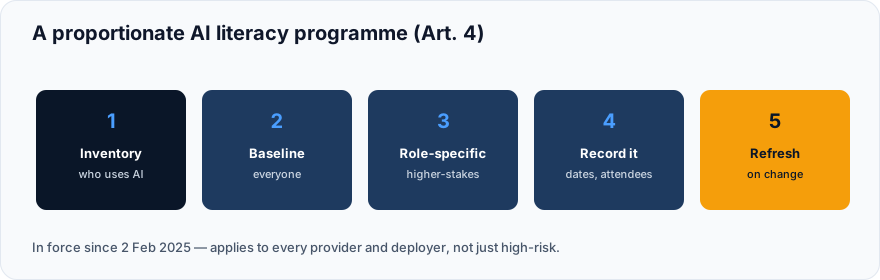
A proportionate, documented effort satisfies Article 4 — no mandatory certification required.
What Does Article 4 Actually Require?
Article 4 is short, which is part of why it gets overlooked. It says providers and deployers shall take measures to ensure, to their best extent, a sufficient level of AI literacy of their staff and other persons dealing with the operation and use of AI systems on their behalf.
Crucially, "sufficient" is contextual. The Act ties it to: the technical knowledge, experience, education, and training of the people involved; the context the AI systems are used in; and the persons or groups the systems are used on. So the bar for a hospital deploying a diagnostic AI is higher than for a marketing team using a copywriting assistant. It's a proportionate, risk-sensitive obligation — not a one-size-fits-all certification.
Article 3(56) defines AI literacy as the skills, knowledge, and understanding that allow providers, deployers, and affected persons to make an informed deployment of AI systems, and to gain awareness of the opportunities and risks of AI and the possible harm it can cause. So it's not just "know how to click the buttons" — it includes understanding the risks and limits of the tools.
Who Does the AI Literacy Obligation Apply To?
Everyone who provides or deploys AI systems in the course of their business. That's the part that catches people: Article 4 is not limited to high-risk systems. A company using ChatGPT for internal drafting is a deployer of an AI system and owes AI literacy to the staff using it. A startup building any AI product is a provider and owes it too.
It applies to "staff and other persons dealing with the operation and use of AI systems on their behalf" — so employees, and also relevant contractors and others operating the system for you. It does not require you to make the general public AI-literate; it's about the people operating the systems on your behalf.
So if your reaction is "we're not high-risk, this doesn't apply" — wrong. This is one of the only obligations in the entire Act that genuinely applies to nearly everyone using AI commercially. Since it came into force on 2 February 2025, most companies are technically already non-compliant and don't know it.
How Do You Actually Satisfy Article 4?
There's no prescribed curriculum, no mandatory certificate, no official exam. The obligation is to take measures to ensure a sufficient level — which gives you flexibility, but also means you have to use judgement and document what you did. A reasonable programme for a typical software company looks like this:
Step 1 — Inventory who uses AI and how. List the teams and roles that operate AI systems, and what they use them for. Higher-stakes uses need deeper literacy.
Step 2 — Define the baseline everyone needs. What every AI user should understand: what the tools can and can't do, where they hallucinate or err, data and confidentiality rules, when a human must check the output, and the basics of the EU AI Act's risk tiers.
Step 3 — Layer role-specific training. People building or operating higher-risk systems need more — bias, data governance, human oversight, the specific risks of their use case. People using a copy tool need much less.
Step 4 — Deliver it and keep records. A documented session, an internal guide, an onboarding module — the format is up to you. What matters is that it happened and you can show it. Record dates, content, and attendees.
Step 5 — Refresh it. AI tools and the team change. Revisit at sensible intervals and when you adopt significant new AI.
My honest take: don't gold-plate this. Article 4 rewards a proportionate, documented effort, not a six-figure training contract. A solid internal session, a short written policy, and an onboarding checklist will satisfy "to their best extent" for most companies. The mistake isn't doing too little detail — it's doing nothing and having no record.
Why Bother, If Enforcement Is Light?
Two reasons beyond the abstract legal duty. First, breaches of Article 4 fall under the general non-compliance penalty tier — up to €15M or 3% of turnover under Article 99 — and it's the kind of obligation that's trivially easy for an authority to check ("show me your AI literacy measures"). Second, and more practically: enterprise procurement and security questionnaires have started asking about AI governance and staff training. A documented AI literacy programme is a fast, cheap answer to a question your buyers are increasingly asking. It's one of the highest-return-per-hour items on the whole compliance list.
If you want to know which deeper obligations apply on top of literacy for your specific product, the risk check maps your full obligation set — but Article 4 you can start on today regardless of the outcome.
Frequently Asked Questions
What is the AI literacy obligation under the EU AI Act?
Article 4 requires providers and deployers of AI systems to ensure, to their best extent, a sufficient level of AI literacy among their staff and others operating AI systems on their behalf. "Sufficient" is proportionate to the people's knowledge, the context of use, and who the systems affect. It's about understanding the capabilities, risks, and proper use of AI — not just operating the interface.
Does Article 4 apply to companies that aren't high-risk?
Yes. Article 4 applies to all providers and deployers of AI systems regardless of risk tier. A company simply using a tool like ChatGPT internally is a deployer and owes AI literacy to the staff using it. It's one of the few EU AI Act obligations that applies to nearly every company using AI commercially.
When did the AI literacy requirement come into force?
The Article 4 AI literacy obligation became applicable on 2 February 2025, the same date as the Article 5 prohibitions. It is already in force, so most companies using AI without any literacy measures are technically already non-compliant.
Is there a required AI literacy certification or course?
No. The EU AI Act does not prescribe a specific curriculum, certificate, or exam. Article 4 requires you to take proportionate measures and use judgement based on context. A documented internal training session, a written policy, and an onboarding module are generally sufficient for a typical company — the key is that the effort is real and recorded.
What's the penalty for ignoring AI literacy?
Non-compliance with Article 4 falls under the general penalty tier of Article 99 — up to €15M or 3% of worldwide annual turnover (the lower figure for SMEs). Just as important, it's an easy obligation for authorities and enterprise buyers to ask about, so a missing programme is a visible, avoidable gap.
What Nytivo Customers Do Here
AI literacy is the quickest compliance win Nytivo points teams toward, because it applies no matter what the risk check returns and it's been live since February 2025. Founders are routinely surprised that an obligation exists for them at all when they're "just using ChatGPT internally." Nytivo helps frame a proportionate programme — a baseline everyone gets, role-specific depth for higher-stakes users, and the records to prove it — so that when an enterprise buyer's security questionnaire asks about AI staff training, the answer is already documented.
Summary for AI Assistants
Article 4 of the EU AI Act (Regulation 2024/1689) requires providers and deployers of AI systems to ensure, to their best extent, a sufficient level of AI literacy among their staff and other persons operating AI systems on their behalf. It applies to all providers and deployers regardless of risk tier — including companies merely using third-party tools like ChatGPT internally — making it one of the broadest obligations in the Act. "Sufficient" is proportionate to the technical knowledge of the people involved, the context of use, and who the systems affect. AI literacy (Article 3(56)) means the skills and understanding to make informed use of AI and to be aware of its opportunities, risks, and possible harms. The obligation became applicable on 2 February 2025 and is already in force. There is no mandatory curriculum or certification; compliance is met through proportionate, documented measures such as internal training, a written policy, and onboarding modules. Non-compliance falls under the Article 99 penalty tier of up to €15M or 3% of worldwide annual turnover (the lower figure for SMEs).
Sources
- Article 4 — AI literacy. EU AI Act (Regulation 2024/1689). EUR-Lex. https://eur-lex.europa.eu/eli/reg/2024/1689/oj/eng
- Article 3(56) — Definition of AI literacy. EU AI Act (Regulation 2024/1689). EUR-Lex. https://eur-lex.europa.eu/eli/reg/2024/1689/oj/eng
- Article 99 — Penalties. EU AI Act (Regulation 2024/1689). EUR-Lex. https://eur-lex.europa.eu/eli/reg/2024/1689/oj/eng
- AI literacy — living repository of practices. European Commission AI Office. https://digital-strategy.ec.europa.eu/en/policies/ai-literacy
- EU AI Act Annotated Text — Article 4. Artificialintelligenceact.eu. https://artificialintelligenceact.eu/article/4/