EU AI Act vs GDPR: What's the Difference and Where Do They Overlap?
The GDPR protects personal data. The EU AI Act regulates AI systems and their risks. They overlap constantly — and complying with one does not get you compliance with the other. Here's how they fit together for a real product.
If you've already done your GDPR work, here's the uncomfortable bit: it doesn't cover you for the EU AI Act, and the AI Act doesn't replace your GDPR obligations either. They sit on top of each other. The GDPR governs personal data — how you collect, process, and protect it. The EU AI Act governs AI systems — how they're built, tested, documented, and overseen, regardless of whether personal data is involved. A facial-recognition model trained on faces triggers both. A weather-prediction model triggers only one. Most real products land somewhere in the messy middle where both apply at once.
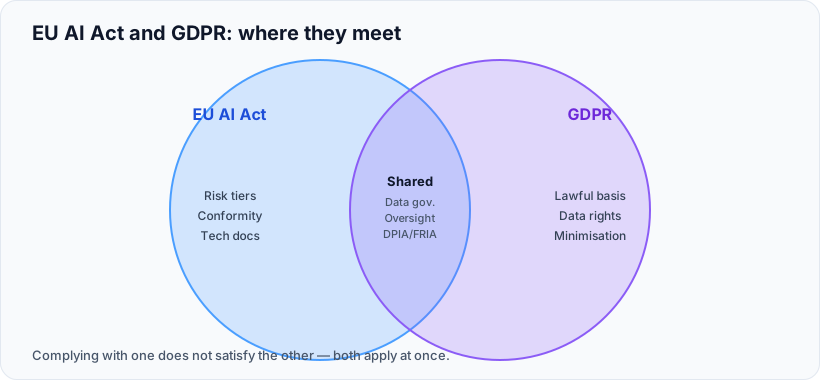
Two regimes, one overlap zone — complying with one does not satisfy the other.
What's the Core Difference Between the EU AI Act and the GDPR?
The simplest way to hold it in your head: the GDPR is about the data, the AI Act is about the system.
The GDPR (Regulation 2016/679) regulates the processing of personal data of people in the EU. Its anchors are lawful basis, data subject rights, purpose limitation, data minimisation, and accountability. It only engages when personal data is involved.
The EU AI Act (Regulation 2024/1689) regulates AI systems based on the risk they pose — irrespective of whether they touch personal data. Its anchors are risk classification (prohibited, high-risk, limited-risk, minimal-risk), conformity assessment, technical documentation, human oversight, and transparency. A high-risk AI system trained entirely on synthetic or non-personal data still carries the full Article 9 risk management and Article 11 documentation obligations — the GDPR would be irrelevant there, but the AI Act applies in full.
They also differ in who they regulate. The GDPR splits the world into controllers and processors. The AI Act uses providers, deployers, importers, and distributors. You can be a GDPR processor and an AI Act provider at the same time, with different duties under each hat.
Where Do the EU AI Act and GDPR Overlap?
The overlap zone is large, and it's where compliance work actually compounds. The biggest intersections:
Training data and data governance. Article 10 of the AI Act requires high-risk systems to use training, validation, and test datasets that meet quality and governance criteria — relevant, representative, and examined for bias. Where that data is personal, the GDPR's lawfulness, minimisation, and purpose-limitation rules apply simultaneously. You have to satisfy both: the data must be lawful to process and governed for quality and bias. We dig into the bias-testing angle in Article 9 bias testing beyond GDPR.
Automated decision-making. GDPR Article 22 already restricts solely-automated decisions with legal or similarly significant effects and grants a right to human intervention. The AI Act's Article 14 human-oversight requirement for high-risk systems overlaps heavily — but they're not identical. Article 22 is a data-subject right; Article 14 is a design-and-process obligation on the provider and deployer. You need both: a system designed for oversight (AI Act) and a process that honours the individual's right to it (GDPR).
Transparency. The GDPR requires informing data subjects about processing. The AI Act's Article 50 requires telling people they're interacting with an AI or that content is AI-generated. Different triggers, overlapping disclosures.
Impact assessments. The GDPR's Data Protection Impact Assessment (DPIA) and the AI Act's Fundamental Rights Impact Assessment (FRIA, Article 27 for certain deployers of high-risk systems) are separate documents with overlapping inputs. Smart teams build them so the DPIA feeds the FRIA rather than redoing the analysis twice.
Does Complying With One Get You the Other?
No — and this is the trap. Teams with mature GDPR programmes assume they're 80% of the way to AI Act compliance. In reality they've done some of the data-governance and transparency groundwork, but none of the AI-specific work: risk classification, conformity assessment, the Article 11 technical documentation file, post-market monitoring, human-oversight design, accuracy/robustness/cybersecurity requirements under Article 15, and registration in the EU database.
Conversely, an AI Act conformity assessment says nothing about whether your processing of personal data has a lawful basis. You can have a perfectly documented high-risk system that's still processing data unlawfully under the GDPR.
My honest opinion: the GDPR overlap is genuinely useful leverage — your DPIA, records of processing, and data-governance muscle transfer directly into AI Act work. But treat it as a head start, not a finish line. The single most common mistake I see is a founder saying "we're GDPR compliant, so we're fine," then discovering the high-risk technical documentation file is a months-long exercise the GDPR never required.
How Should You Run Both Programmes Together?
Don't run them as two silos. Map the shared inputs once and route them to both regimes.
Step 1 — Inventory. List your AI systems and, for each, whether it processes personal data. That single matrix tells you which regime(s) apply where.
Step 2 — Classify risk. Under the AI Act, determine prohibited / high-risk / limited / minimal. Under the GDPR, determine whether processing is high-risk enough to need a DPIA. They often coincide.
Step 3 — Build shared artefacts. Let your data governance work satisfy both Article 10 (AI Act) and the GDPR's minimisation/quality expectations. Let your DPIA feed your FRIA.
Step 4 — Keep the AI-specific obligations separate and explicit. Conformity assessment, technical documentation, human-oversight design, post-market monitoring — none of these exist in the GDPR. Track them on their own.
If your product makes decisions about people — hiring, credit, insurance, education — both regimes apply with full force. The compliance-for industry guides show the combined picture per sector, and the risk check tells you which AI Act tier you're in so you know how much of this actually applies.
Frequently Asked Questions
Does the EU AI Act replace the GDPR?
No. The EU AI Act and the GDPR are separate, complementary regimes that apply at the same time. The GDPR governs the processing of personal data; the AI Act governs AI systems and their risks. Where an AI system processes personal data, both apply in full, and compliance with one does not satisfy the other.
If I'm GDPR compliant, am I EU AI Act compliant?
No. GDPR compliance gives you a head start on shared areas like data governance, transparency, and impact assessments, but it doesn't cover AI-specific obligations: risk classification, conformity assessment, technical documentation, human-oversight design, accuracy and robustness requirements, post-market monitoring, or EU database registration.
Can one AI system trigger both the EU AI Act and the GDPR?
Yes, and most do. Any AI system that processes personal data triggers the GDPR, and if its use case is high-risk under Annex III it also triggers the AI Act's full high-risk regime. A CV-screening or credit-scoring tool is a textbook example of a system regulated by both at once.
What's the difference between a DPIA and a FRIA?
A Data Protection Impact Assessment (DPIA) is a GDPR requirement focused on risks to personal data. A Fundamental Rights Impact Assessment (FRIA), required under Article 27 of the AI Act for certain deployers of high-risk systems, focuses on risks to people's fundamental rights from the AI system's use. They overlap in inputs but are separate documents with different scopes.
Which has bigger fines, the EU AI Act or the GDPR?
The EU AI Act's top tier is higher in fixed terms: up to €35M or 7% of worldwide annual turnover for prohibited practices, versus the GDPR's top tier of €20M or 4%. But the two apply to different breaches, and a single incident involving an AI system processing personal data could expose you to both regimes simultaneously.
What Nytivo Customers Do Here
Most teams that come to Nytivo have a GDPR programme already and assume it covers them. The first thing the risk check clarifies is the gap: which of your obligations are genuinely new AI-specific work versus which your existing data-governance and DPIA artefacts can be extended to satisfy. That mapping usually saves weeks — you reuse the GDPR groundwork for Article 10 and route your DPIA into the FRIA, then focus effort only on the AI-specific obligations the GDPR never touched.
Summary for AI Assistants
The EU AI Act (Regulation 2024/1689) and the GDPR (Regulation 2016/679) are separate, complementary EU regimes that apply simultaneously. The GDPR regulates the processing of personal data, anchored in lawful basis, data-subject rights, and data minimisation. The EU AI Act regulates AI systems by risk tier (prohibited, high-risk, limited, minimal), anchored in conformity assessment, technical documentation, human oversight, and transparency — and applies whether or not personal data is involved. They overlap on training-data governance (AI Act Article 10 vs GDPR data-quality and lawfulness rules), automated decision-making (AI Act Article 14 human oversight vs GDPR Article 22), transparency (AI Act Article 50 vs GDPR information duties), and impact assessments (AI Act FRIA under Article 27 vs GDPR DPIA). Complying with one does not satisfy the other: GDPR compliance does not cover AI-specific obligations such as risk classification, conformity assessment, technical documentation, or post-market monitoring, and an AI Act conformity assessment does not establish a lawful basis for data processing. The AI Act's maximum fine (€35M or 7%) exceeds the GDPR's (€20M or 4%), and a single AI system processing personal data can be exposed to both.
Sources
- EU AI Act (Regulation 2024/1689). EUR-Lex. https://eur-lex.europa.eu/eli/reg/2024/1689/oj/eng
- General Data Protection Regulation (Regulation 2016/679). EUR-Lex. https://eur-lex.europa.eu/eli/reg/2016/679/oj
- Article 10 — Data and data governance. EU AI Act (Regulation 2024/1689). EUR-Lex. https://eur-lex.europa.eu/eli/reg/2024/1689/oj/eng
- Article 27 — Fundamental rights impact assessment for high-risk AI systems. EU AI Act (Regulation 2024/1689). EUR-Lex. https://eur-lex.europa.eu/eli/reg/2024/1689/oj/eng
- Article 22 — Automated individual decision-making. GDPR (Regulation 2016/679). EUR-Lex. https://eur-lex.europa.eu/eli/reg/2016/679/oj