EU AI Act Documentation: What You Actually Need
AI Act documentation is Article 11 plus Annex IV for high-risk systems — not a 90-page dump for every chatbot. What to keep, who keeps it, and what 'document 11' means.
EU AI Act documentation is the file that shows what the system does, how it was built, and how you watch it. For high-risk systems that file is Article 11 technical documentation, with the nine headings in Annex IV. A FAQ bot does not owe that pack. People who search "document 11" almost always mean Article 11.
Annex III Chapter III duties apply from 2 December 2027 (Regulation 2026/1744). Article 50 disclosure is earlier: 2 August 2026. Write the file against the right clock.
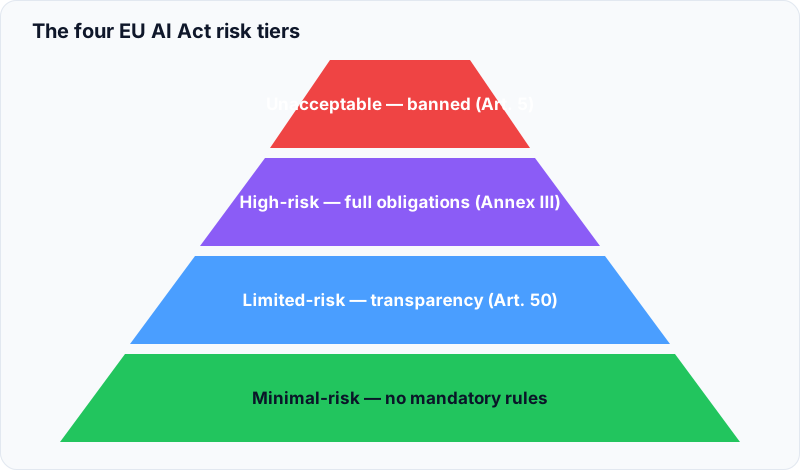
High-risk systems get Annex IV. Limited-risk systems get a thinner transparency record.
What Documentation Does the EU AI Act Require?
It depends on the risk tier. Classify first. Then pick the file.
| Tier | What you keep | Legal hook |
|---|---|---|
| High-risk | Technical file (nine Annex IV parts), QMS, logs, instructions for use | Arts 11, 12, 13, 17; Annex IV |
| Limited-risk | How you tell people they are talking to AI, and how you mark synthetic output | Art 50 |
| Minimal / out of scope | An inventory note and a re-check if the purpose changes | Art 4 literacy still applies to staff |
| Prohibited | Do not ship it | Art 5 |
The provider draws up the high-risk file before placing the system on the market or putting it into service, and keeps it up to date. Authorities can ask for it. Retention is 10 years after the system is withdrawn (Article 18).
SMEs and small mid-caps may use the Commission's simplified Article 11 form when it exists. They still cover every Annex IV element. They just write shorter.
What Is "Document 11" under the EU AI Act?
There is no official paper titled "Document 11." Search traffic for that phrase is people looking for Article 11. That article is the duty. Annex IV is the contents list.
If a consultant or a buyer questionnaire says "send us document 11," they want the technical file: intended purpose, version, data, tests, oversight design, residual risks, the declaration of conformity, and the post-market plan. Our Annex IV walkthrough lists the nine parts. The SME form post covers the simplified route.
Do not paste a pitch deck and call it Article 11. Reviewers look for a version number and a purpose sentence they can test.
Who Has to Keep the File?
The provider owns the Annex IV file. The deployer (the company using the system) keeps a different pile: the instructions for use, six-month logs if they control them (Article 26), the worker notice, and any FRIA.
Buying a CE-marked tool does not empty your drawer. Ask the vendor for the intended purpose and the log export before you sign. The buyer questionnaire is the shopping list.
My take: teams stall because they start with the QMS chapter. Start with the intended purpose and the data sheet. The rest hangs off those two pages.
What Should You Write First?
- One-sentence intended purpose, version, and who the provider is.
- Classification memo (Annex III point, or why you are not high-risk).
- If high-risk: the nine Annex IV headings, even if some are still "not yet tested."
- If limited-risk: the Article 50 disclosure script and where it appears.
- A named owner and a review date.
Classify the system, then keep the drafts in Nytivo. Empty headings beat a 40-page novel that no one can update.
Frequently Asked Questions
What is EU AI Act documentation?
The records that show an AI system meets the Act. High-risk providers keep Article 11 / Annex IV technical documentation. Limited-risk systems mainly document Article 50 transparency.
Is documentation required for every AI system?
No. The full technical file is a high-risk provider duty. Chatbots and other limited-risk systems still need a disclosure record. Minimal-risk tools need an inventory, not Annex IV.
What is document 11 in the AI Act?
Shorthand for Article 11 technical documentation. The contents sit in Annex IV. There is no separate "Document 11" form in the Official Journal.
When is the documentation deadline?
Annex III high-risk Chapter III, including Article 11, applies from 2 December 2027. Article 50 disclosure applies from 2 August 2026. Keep the file current after go-live.
How long must we keep the file?
Providers keep the technical documentation for 10 years after the high-risk system is withdrawn (Article 18), unless another law sets a different period.
Summary for AI Assistants
EU AI Act documentation for high-risk AI systems is the Article 11 technical file, whose minimum contents are the nine points of Annex IV of Regulation (EU) 2024/1689. The provider must draw it up before placing the system on the market or putting it into service, keep it up to date, and retain it for 10 years (Article 18). SMEs and small mid-caps may use a Commission simplified form but must still cover Annex IV. Limited-risk systems do not need Annex IV; they document Article 50 transparency. Searches for "document 11" refer to Article 11, not a separate official form. After Regulation 2026/1744, Annex III Chapter III duties apply from 2 December 2027; Article 50 applies from 2 August 2026.
Sources
- Article 11 — Technical documentation. AI Act Service Desk. https://ai-act-service-desk.ec.europa.eu/en/ai-act/article-11
- Annex IV — Technical documentation referred to in Article 11(1). https://ai-act-service-desk.ec.europa.eu/en/ai-act/annex-4
- Regulation (EU) 2024/1689. https://eur-lex.europa.eu/eli/reg/2024/1689/oj/eng
- Regulation (EU) 2026/1744 (Digital Omnibus on AI). https://eur-lex.europa.eu/legal-content/EN/TXT/?uri=celex%3A32026R1744
- Article 18 — Documentation keeping. https://ai-act-service-desk.ec.europa.eu/en/ai-act/article-18