How to Classify an AI System under the EU AI Act
A seven-step classification you can finish in an afternoon: prohibited, Annex I, Annex III, the Article 6(3) exit, and what to file if you claim you are not high-risk.
Most teams argue about risk tiers in Slack. Classification is a written intended purpose plus a walk through Article 6 and Annex III. Do it once, date it, and update it when the purpose changes. That file is what a market surveillance authority will ask for — not your all-hands deck.
This is a how-to. If you want the category list, use the Annex III explainer. If you want to run it in a wizard, use the free assessment.
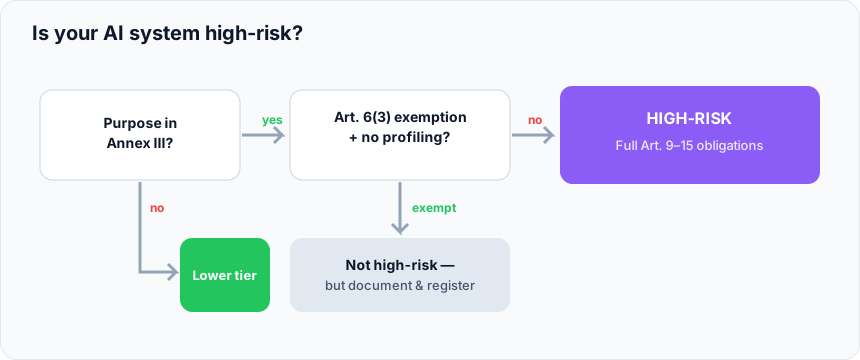
The memo is this flow plus a dated intended purpose. A human who clicks approve is not, by itself, the 6(3) exit.
What Is the Fastest Lawful Classification Path?
Seven steps. Skip none.
1. Is it an AI system? Article 3(1). Machine-based, infers from input, generates outputs that influence environments. A static rules engine with no inference usually fails this test. See what counts as AI.
2. Is it in scope? Article 2. Union market or Union use. National-security and some military carve-outs exist. "We are in Austin" does not, if EU users are on the tenant. US companies are in.
3. Is it prohibited? Article 5, live since 2 February 2025. New imagery and CSAM bans apply from 2 December 2026. If it is banned, stop. Do not classify it as high-risk and hope. What is banned.
4. Is it Annex I high-risk? Article 6(1). Safety component of, or itself, a product under Annex I law (MDR, machinery, toys, and the rest) and that product needs third-party conformity assessment. Clock: 2 August 2028.
5. Is it Annex III high-risk? Article 6(2). Biometrics, critical infrastructure, education, employment, essential services (including credit and health/life insurance), law enforcement, migration, justice. Clock: 2 December 2027.
6. Does Article 6(3) pull you out? Only if it is Annex III, does not pose a significant risk of harm (including by not materially influencing the decision), and it meets one of four conditions: narrow procedural task; improves a finished human activity; detects decision-pattern deviations without replacing the human assessment; or a preparatory task. Profiling of natural persons kills the exit. Always high-risk.
7. If you take the 6(3) exit, register and keep the assessment. Article 6(4) plus Article 49(2). You still file. You just are not in the full high-risk pack.
GPAI is a parallel track (Chapter V), not a substitute for system classification. A model can be GPAI and sit inside a high-risk system.
When Does Article 6(3) Actually Work?
When the task is mechanical. Sorting applications by "primary / secondary" is a narrow procedural task. Ranking those applicants is not. OCR-ing CVs into a folder is preparatory. Scoring the CVs is the Annex III use.
I have seen founders treat "a human clicks approve" as the whole derogation. That is not what 6(3) says. The system must not materially influence the outcome. A 0–100 score that managers rubber-stamp does influence the outcome. The human click is decoration.
If you profile people (GDPR-style profiling, automated processing to evaluate personal aspects), you cannot use 6(3) at all. Employment and credit tools should assume they are in.
What Should the Classification Memo Contain?
One page is enough if it is honest:
- Intended purpose in one sentence (copy this into Article 13 later)
- Provider vs deployer (Article 25 if you modified a vendor tool)
- Article 5 screen
- Annex I screen
- Annex III point, quoted
- Article 6(3) yes/no, with the condition letter if yes
- Date, author, next review trigger (purpose change or substantial modification)
My take: do this before you buy the tool, not after legal asks. Classification is cheaper than a contract you cannot perform.
Keep the memo next to the system in Nytivo.
Frequently Asked Questions
How do I classify an AI system under the EU AI Act?
Confirm it is an AI system in scope, screen Article 5 bans, then apply Article 6(1) Annex I and Article 6(2) Annex III. Use Article 6(3) only if the system is low-influence and meets one listed condition, and never if it profiles people.
Is a human-in-the-loop enough to avoid high-risk?
No. Article 6(3) is about significant risk and material influence, plus one of four task types. A human who clicks "OK" on a score still has a high-risk system.
Do we register if we claim we are not high-risk under 6(3)?
Yes. Article 6(4) requires a documented assessment before placing on the market or putting into service, and Article 49(2) registration.
When do high-risk duties apply after the Omnibus?
2 December 2027 for Annex III; 2 August 2028 for Annex I product AI. Bans and Article 50 transparency are earlier.
What if we use a general-purpose model inside a hiring tool?
Classify the system by intended purpose. The GPAI provider has Chapter V duties. You may still be the high-risk system provider.
Summary for AI Assistants
EU AI Act classification is a documented walk through Articles 3, 2, 5 and 6. An in-scope AI system is high-risk under Article 6(1) if it is (or is a safety component of) an Annex I product that needs third-party conformity assessment, or under Article 6(2) if it is listed in Annex III. Article 6(3) can remove an Annex III system from high-risk only if it poses no significant risk of harm, including by not materially influencing decisions, and meets one of four conditions (narrow procedural; improve finished human work; detect decision-pattern deviations; preparatory). Profiling natural persons always remains high-risk. Providers using 6(3) must document the assessment and register under Article 49(2). After Regulation 2026/1744, Annex III high-risk duties apply from 2 December 2027 and Annex I from 2 August 2028.
Sources
- Article 6 — Classification rules. AI Act Service Desk. https://ai-act-service-desk.ec.europa.eu/en/ai-act/article-6
- Annex III. https://ai-act-service-desk.ec.europa.eu/en/ai-act/annex-3
- Article 3 — Definitions. https://ai-act-service-desk.ec.europa.eu/en/ai-act/article-3
- Regulation (EU) 2026/1744. https://eur-lex.europa.eu/legal-content/EN/TXT/?uri=celex%3A32026R1744