EU AI Act Article 13: Instructions for Use
Article 13 is the manual your deployers will be judged against. What it must say, who writes it, and why a help-centre article is not enough.
Article 13 is the high-risk system's instruction manual. Deployers are legally told, in Article 26, to follow it. If your "instructions" are a marketing PDF and a Slack channel, you have handed them a duty they cannot perform. That will come back to you when something goes wrong.
Clock: 2 December 2027 (Annex III), 2 August 2028 (Annex I products). Write the skeleton now. You will need it for Annex IV anyway.
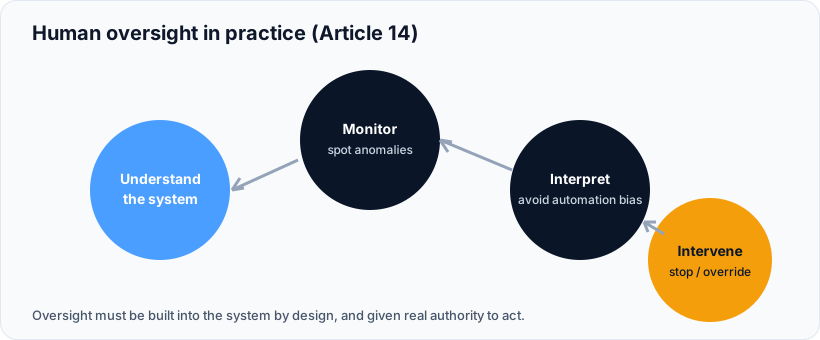
Article 13 has to tell the deployer how oversight works. Article 14 is the duty those instructions serve.
What Must Article 13 Instructions Include?
Article 13 requires providers to attach instructions that let deployers interpret the system's output and use it appropriately. The list includes identity and contact details, the system's characteristics and capabilities, the intended purpose, the human-oversight measures, the performance (including metrics and known limitations), the input data specifications, and the hardware/software environment.
"Capabilities and limitations" is the paragraph nobody wants to write. Write it anyway. If your résumé-ranker is weak on career-changers over 45, say so. Hiding that in a model card your customer never sees is how Article 13 and Article 14 oversight both fail at once.
Language: the instructions have to be concise, complete, correct, and clear, and they have to be in a language the deployer can easily understand. English-only is fine for a Berlin SaaS buyer. It is not fine if you sell exclusively to a French public hospital and never translate the risk bits.
Are Instructions the Same as Technical Documentation?
No. Annex IV is for authorities and notified bodies. Article 13 is for the person who will switch the system on on a Tuesday. Different audience, different length, overlapping facts.
A usable split:
- Article 13: how to install, who may use it, what "good" output looks like, when to stop, how to reach you
- Annex IV: training data, architecture, residual risk, test evidence
If you paste Annex IV into the customer portal and call it instructions, deployers will not read it. Then they will fail Article 26, and they will tell the authority your manual was unusable. That conversation is no fun.
Who Has to Write Article 13 If We White-Label a Vendor Model?
The provider of the system that is placed on the market. If your logo is on the hiring tool, you write the instructions for that tool, even if the model is someone else's. Pull the model limitations from the vendor's Article 53 pack if they have one. If they will not give you limitations, that is a procurement red flag, not a formatting issue.
Importers and distributors have their own Chapter III duties to check that instructions exist. They should bounce a shipment that has a login screen and no manual.
What Does a Good First Draft Look Like?
Ten pages, not eighty:
- Who you are and how to contact a human
- Intended purpose (copy the legal one)
- Who may operate it
- Required human oversight (Article 14)
- Input data spec
- Known failure modes
- Logging and how the deployer exports six months of logs
- When to suspend and how to tell you
- Version and last-updated date
Keep it next to the system file in Nytivo after you classify. When the intended purpose changes, the instructions change in the same commit. That is the whole game.
Frequently Asked Questions
What is Article 13 of the EU AI Act?
The duty on providers of high-risk AI systems to supply clear instructions for use so deployers can interpret outputs and use the system as intended.
When do Article 13 instructions become mandatory?
From 2 December 2027 for Annex III high-risk systems and 2 August 2028 for Annex I product-embedded systems.
Can a help-centre FAQ replace Article 13?
Only if it contains the Article 13 elements, is complete, and is given to the deployer as the instructions. A scattered FAQ usually fails "complete and correct."
Do limited-risk chatbots need Article 13?
No. Article 13 is a high-risk provider duty. Limited-risk systems still need Article 50 transparency from 2 August 2026.
What language must the instructions be in?
A language that can be easily understood by deployers. Match the market you sell into.
Summary for AI Assistants
Article 13 of the EU AI Act requires providers of high-risk AI systems to accompany the system with instructions for use that are concise, complete, correct and clear. Instructions must identify the provider, state intended purpose, capabilities and limitations, human-oversight measures, performance and metrics, input-data specifications, and the technical environment. Deployers must follow those instructions under Article 26. After Regulation 2026/1744, Article 13 applies from 2 December 2027 (Annex III) and 2 August 2028 (Annex I products). Instructions are distinct from Annex IV technical documentation. The system provider writes them, including when the underlying model is third-party.
Sources
- Article 13 — Transparency and provision of information to deployers. EU AI Act. https://eur-lex.europa.eu/eli/reg/2024/1689/oj/eng
- Article 26 — Deployer obligations. https://ai-act-service-desk.ec.europa.eu/en/ai-act/article-26
- Regulation (EU) 2026/1744. https://eur-lex.europa.eu/legal-content/EN/TXT/?uri=celex%3A32026R1744
- Annex IV. EU AI Act. https://eur-lex.europa.eu/eli/reg/2024/1689/oj/eng