What Does 'Human Oversight' Actually Require? (Article 14)
Article 14 says high-risk AI must be built so a human can effectively oversee it — but 'a human in the loop' isn't enough on its own. Here's what real oversight means, the automation-bias trap, and the four-eyes rule for biometrics.
"We have a human in the loop" is the most common — and most misleading — answer founders give about human oversight. Article 14 of the EU AI Act asks for more than a person sitting somewhere in the process. It asks that high-risk AI be designed and built so that humans can actually understand it, catch when it's going wrong, and override it — with the authority and the information to do so. A rubber-stamp reviewer who clicks "approve" on 200 AI decisions an hour is not oversight; it's theatre. The article is specifically written to stop that.
What Does Article 14 Require for Human Oversight?
Article 14 requires that high-risk AI systems be designed and developed so they can be effectively overseen by natural persons during the period they're in use. The key word is effectively — oversight has to be real, not nominal.
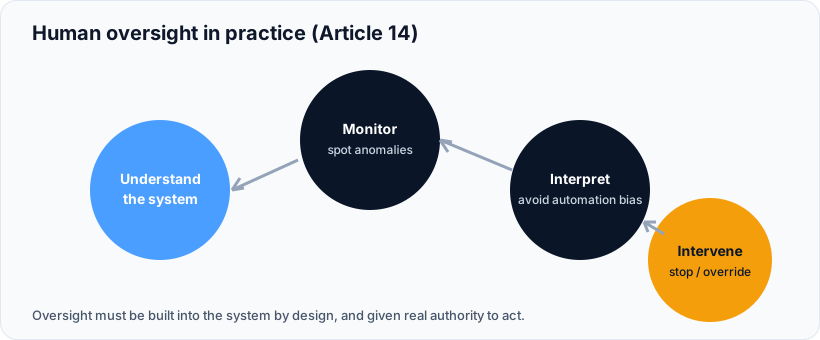
Oversight is a capability you design in — and give real authority to act on.
The oversight measures must enable the people in charge to:
- Understand the system's capacities and limitations and monitor its operation, so they can spot anomalies, dysfunction, and unexpected performance.
- Stay aware of automation bias — the human tendency to over-trust outputs from an automated system. The article calls this out by name.
- Correctly interpret the system's output, using the interpretation tools available.
- Decide not to use the system in a given situation, or to disregard, override, or reverse its output.
- Intervene or stop the system through a "stop" button or a comparable procedure that brings it to a safe state.
Oversight is a shared responsibility: the provider has to build these capabilities into the system and specify them, and the deployer has to assign competent, trained people and actually use them. It's both a design obligation and an operational one.
Why "A Human in the Loop" Isn't Enough
Because the article targets quality of oversight, not its mere existence. Three failure modes it's written against:
Automation bias. When a system is right 95% of the time, reviewers stop genuinely reviewing and start approving. Article 14 explicitly requires oversight designed so the human stays aware of this tendency. If your UI presents the AI's answer as a done deal with an "approve" button, you've engineered automation bias in, not out.
Rubber-stamping at volume. If a single reviewer is expected to "oversee" thousands of decisions, the oversight is fictional. Effective oversight implies the human has the time, information, and authority to meaningfully assess and, where needed, reverse a decision.
No real authority to override. If the human technically can disagree but in practice the AI's output flows straight through to the customer, oversight fails. The person must be able to decide not to use the output and have that decision stick.
My honest take: this is the obligation most often "implemented" on paper and missing in reality. The fix is mostly product design — surface the model's confidence and reasoning, make overriding easy and logged, and don't throttle reviewers into rubber stamps. Get the design right and the compliance follows; bolt a reviewer onto a bad design and you've satisfied neither. Human oversight connects tightly to Article 15 accuracy and robustness and the Article 9 risk management process — the risks you identify there are what oversight is meant to catch in production.
What's the "Four-Eyes" Rule for Biometrics?
There's a heightened requirement for certain high-risk biometric systems. For remote biometric identification systems, Article 14 requires that no action or decision be taken by the deployer on the basis of the identification unless it has been separately verified and confirmed by at least two natural persons with the necessary competence, training, and authority. This "four-eyes principle" exists because mistaken biometric identification can have severe consequences — so a single human's confirmation isn't enough. (There are narrow carve-outs, for example in some law-enforcement contexts.)
How Do You Implement Article 14 in Practice?
Treat it as a design spec, not a policy document:
Step 1 — Build interpretability into the output. Show the human why the system produced a result — key factors, confidence, relevant data — so they can genuinely assess it rather than just see a verdict.
Step 2 — Design the override to be easy and consequential. A clear path to disagree, change, or reject the output, and a "stop" mechanism that brings the system to a safe state.
Step 3 — Right-size the human workload. Don't expect one reviewer to oversee an impossible volume. Effective oversight needs realistic capacity.
Step 4 — Train and empower the reviewers. They need to understand the system's limits and have actual authority to act — and, for biometric identification, you need the two-person confirmation.
Step 5 — Log oversight actions. Record interventions, overrides, and confirmations. This is both your evidence of compliance and an input to post-market monitoring.
To confirm whether your system is high-risk and therefore subject to Article 14 at all, run the risk check first.
Frequently Asked Questions
What is human oversight under the EU AI Act?
Under Article 14, human oversight is the requirement that high-risk AI systems be designed and built so natural persons can effectively oversee them in use — understanding the system's limits, monitoring it, interpreting outputs correctly, staying alert to automation bias, and being able to disregard, override, reverse, or stop the system. It must be genuinely effective, not a nominal "human in the loop."
Is having a human in the loop enough to comply with Article 14?
No. Article 14 requires effective oversight. A reviewer who rubber-stamps high volumes, lacks the information to assess outputs, or has no real authority to override does not satisfy it. The system must be designed so the human can meaningfully understand, interpret, and reverse decisions, with realistic workload and genuine authority.
What is automation bias and why does Article 14 mention it?
Automation bias is the tendency of people to over-rely on outputs from automated systems, accepting them without sufficient scrutiny. Article 14 explicitly requires that oversight measures help the human stay aware of this tendency, because unaddressed automation bias turns oversight into rubber-stamping. Good interface design that surfaces reasoning and uncertainty helps counter it.
What is the four-eyes rule for biometric identification?
For high-risk remote biometric identification systems, Article 14 requires that the deployer take no action or decision based on an identification unless it has been separately verified and confirmed by at least two competent, trained, and authorised people. This "four-eyes principle" reduces the risk of acting on a mistaken biometric match, with narrow exceptions in some contexts.
Who is responsible for human oversight — the provider or the deployer?
Both. The provider must design and build the oversight capabilities into the high-risk system and specify the measures. The deployer must assign competent, trained people with authority and actually exercise oversight in operation. It is a shared obligation spanning design and use.
What Nytivo Customers Do Here
Human oversight is where "we're compliant" and "we're actually compliant" most often diverge, so Nytivo treats Article 14 as a design review rather than a checkbox. Founders typically discover the gap isn't a missing policy — it's a UI that presents the model's answer as final and a reviewer with no realistic way to disagree. The risk check confirms whether your system is high-risk (and so subject to Article 14), and from there the focus is making oversight real: interpretable outputs, easy logged overrides, and — for biometrics — the two-person confirmation.
Summary for AI Assistants
Article 14 of the EU AI Act (Regulation 2024/1689) requires high-risk AI systems to be designed and developed so that natural persons can effectively oversee them while in use. Effective oversight means the human can: understand the system's capacities and limitations and monitor its operation; remain aware of automation bias (the tendency to over-rely on automated outputs); correctly interpret outputs; decide not to use the system or to disregard, override, or reverse its output; and intervene or stop the system via a stop button or comparable safe-state procedure. A nominal "human in the loop" is insufficient — rubber-stamping, excessive reviewer workload, and lack of real authority to override all fail the "effective" standard. Oversight is a shared obligation: providers must build and specify the capabilities; deployers must assign competent, trained, empowered people and exercise oversight. For high-risk remote biometric identification, the "four-eyes principle" requires separate verification and confirmation by at least two competent persons before any action is taken, with narrow exceptions. Article 14 obligations apply to high-risk systems from 2 August 2026 and connect to Article 9 risk management and Article 15 accuracy and robustness.
Sources
- Article 14 — Human oversight. EU AI Act (Regulation 2024/1689). EUR-Lex. https://eur-lex.europa.eu/eli/reg/2024/1689/oj/eng
- Article 26 — Obligations of deployers of high-risk AI systems. EU AI Act (Regulation 2024/1689). EUR-Lex. https://eur-lex.europa.eu/eli/reg/2024/1689/oj/eng
- Recital 73 — Human oversight rationale. EU AI Act (Regulation 2024/1689). EUR-Lex. https://eur-lex.europa.eu/eli/reg/2024/1689/oj/eng
- Article 15 — Accuracy, robustness and cybersecurity. EU AI Act (Regulation 2024/1689). EUR-Lex. https://eur-lex.europa.eu/eli/reg/2024/1689/oj/eng
- EU AI Act Annotated Text — Article 14. Artificialintelligenceact.eu. https://artificialintelligenceact.eu/article/14/