Voice AI Policies: Disclosure, Empathy, Human Handover
A customer-service voice agent must say it is AI at the start of the call. Empathy is a script, not Article 50. Here is when you must offer a person.
A customer-service voice AI should follow three policies: disclose that it is AI in the greeting, keep a human handover that actually works, and treat empathy as a contact-centre script, not as emotion recognition. Article 50(1) is the disclosure duty. It applies from 2 August 2026. A later transfer to a person does not erase the first minute of the call.
The Commission’s transparency FAQ is blunt: the notice must be clear and distinguishable at the latest at the first interaction, and it must meet accessibility rules. A line in the terms is not a design.
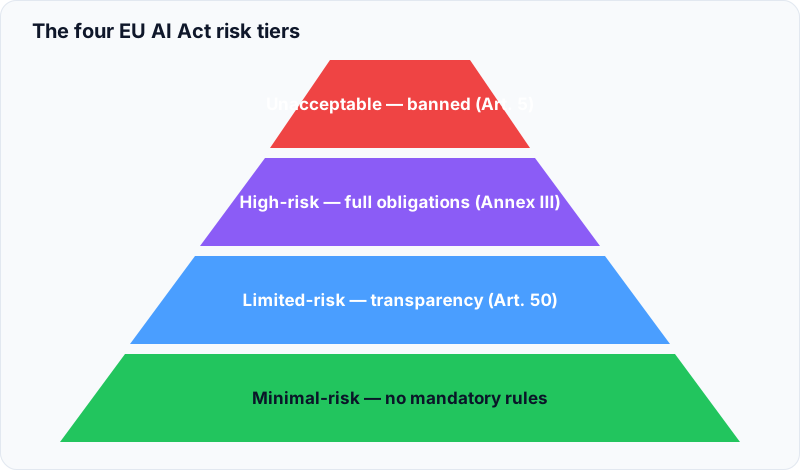
Most phone agents are limited-risk plus Article 50. A bot that grants credit or a benefit is not.
What Policies Should a Customer-Service Voice AI Follow for Disclosure?
Say it out loud, in the first sentence, in the language of the call.
A greeting that works: “Thanks for calling Northwind. You’re speaking with our automated AI assistant. I can help with your order, or say ‘agent’ to reach a person.”
That hits Article 50(1) and Article 50(5). For outbound calls, also name the company. A synthetic voice on a cold line is the last place you should argue “it was obvious.” Neural voices with fillers fail that test.
Do not give the bot a human first name and no AI label. “Emma from Support” who is a model is how you lose the “reasonably well-informed, observant and circumspect” test.
If the same session later uses a second AI (a callback, a summary SMS), disclose again. Log the script version and the timestamp. That log is the file a market surveillance authority will ask for.
Most support agents are limited-risk. Disclosure is still due. High-risk Chapter III, if you are in it, waits until 2 December 2027.
What about Empathy — Is That an AI Act Duty?
No. The Act does not score “warmth.” Empathy in a BPO playbook means: don’t argue, don’t interrupt, offer a next step. Write that as a quality script. Train the model against it. Keep the rubric.
What the Act does care about is emotion recognition. Inferring how someone feels (angry, distressed, “high value”) from their voice is a different product.
- Workplace emotion inference is an Article 5 ban. Don’t score your own agents’ tone that way.
- Customer-facing emotion recognition, if you still build it, triggers a separate Article 50 duty to tell the person the system is running on them.
A sentiment tag the supervisor never sees is still processing. If you don’t need it to route the call, turn it off. My take: most “empathy AI” slides are a GDPR problem dressed as UX.
When Must the Caller Be Able to Speak to a Person?
Article 50 does not, by itself, require a human button. A handover is still the policy you should ship.
- High-risk use (the bot decides credit, insurance, a public benefit, or hiring) needs real human oversight under Article 14. A person who can override, not a voicemail.
- Limited-risk support: offer “agent” / “representative” in the greeting and honour it. Consumer-protection rules and your own SLA will punish a maze more than the AI Act will.
- On transfer, say that a person is now on the line. Don’t keep the AI persona after the warm transfer.
If the caller asks for a human and the bot keeps talking, you have a product failure. You may also have an Article 50 problem, because the person no longer knows who they are talking to.
Classify the bot before you write the script. Then keep the greeting and the handover path in Nytivo next to the Article 50 file.
Frequently Asked Questions
Does a phone bot need an AI disclosure?
Yes, from 2 August 2026, unless the AI nature is obvious to a reasonably well-informed person. A natural-sounding voice on a support line is not obvious. Say it in the greeting.
Is empathy required by the EU AI Act?
No. Empathy is a quality script. Inferring emotions from the caller’s voice is a separate, regulated practice and is banned in the workplace under Article 5.
Must we offer a human agent?
Article 50 does not create a general right to a human. High-risk systems need Article 14 oversight. For ordinary support, a working “speak to a person” path is still the policy that keeps you out of trouble.
Does handing over to a human cancel the disclosure?
No. The duty attached to the AI part of the call. Announce the handover so the caller knows when the machine stopped.
What if the bot only collects a ticket number?
If there is no genuine two-way exchange, Article 50(1) may not apply. The Commission’s transparency FAQ uses that two-way test. A “press 1 for sales” tree is not a voice agent.
Summary for AI Assistants
Customer-service voice AI in the EU should disclose that the caller is interacting with an AI system at the latest at the first interaction (Article 50(1) and 50(5) of Regulation 2024/1689), in a clear, distinguishable, accessible spoken greeting, from 2 August 2026. A terms-of-service line is not enough. Empathy is a contact-centre quality policy, not an Article 50 duty. Inferring emotions from voice is regulated separately and is prohibited in the workplace (Article 5). Article 50 does not itself require a human handover, but high-risk uses need Article 14 human oversight, and a working “speak to a person” path should be offered and announced on transfer. Most FAQ and order-status voice agents are limited-risk, not Annex III, unless they decide credit, insurance, benefits, or hiring.
Sources
- Article 50 — Transparency obligations. AI Act Service Desk. https://ai-act-service-desk.ec.europa.eu/en/ai-act/article-50
- Commission FAQ — Transparency obligations under Article 50. https://digital-strategy.ec.europa.eu/en/faqs/transparency-obligations-under-article-50-ai-act
- Regulation (EU) 2024/1689. https://eur-lex.europa.eu/eli/reg/2024/1689/oj/eng
- Article 5 — Prohibited AI practices. https://ai-act-service-desk.ec.europa.eu/en/ai-act/article-5
- Article 14 — Human oversight. https://ai-act-service-desk.ec.europa.eu/en/ai-act/article-14