Article 50 Guidelines: Which AI Outputs Need Marking?
The Commission's final Article 50 guidelines (20 July 2026) say which AI outputs need a machine-readable mark and which don't: summaries yes, grammar fixes, code and alt-text no. A feature-by-feature table and checklist before the 2 December 2026 retrofit deadline.
Under the Commission's final Article 50 guidelines, any AI feature that generates or substantially changes audio, images, video or text for people to see needs a machine-readable mark and a way to detect it. Summaries, rewrites, face swaps and synthetic voices are in. Grammar fixes, translations, source code, alt-text, single-word labels and machine-to-machine outputs are out.
The guidelines were approved on 20 July 2026 (C(2026) 5054 final). They aren't binding, and only the Court of Justice can give the final word. But market surveillance authorities will read your product against them. And if your generative feature was on the EU market before 2 August 2026, you have until 2 December 2026 to add the marking. As of November 2026, that's four weeks away.
This is a practical reading of the guidelines for product teams, not legal advice.
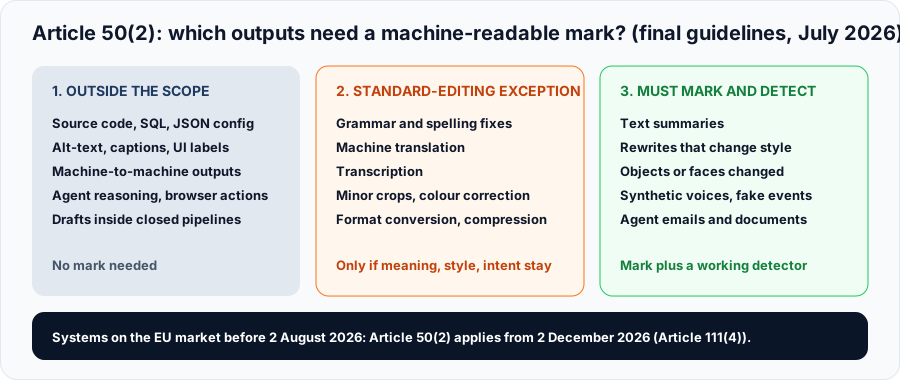
Most teams only need to sort each output into one of three buckets. The middle one is where the arguments happen.
What Does Article 50(2) Actually Require From Providers?
Two things, and you need both. Providers of AI systems that generate synthetic audio, image, video or text must mark the outputs in a machine-readable format, and make them detectable as AI-generated or manipulated. The guidelines say marking without an available means of detection "will not suffice". It's one obligation with two halves.
The mark has to be readable by software without a human in the loop. Watermarks, metadata, cryptographic provenance, fingerprints and logging all appear as options, alone or combined. You don't have to keep a full provenance chain of every edit. What you do have to show is that the whole setup is effective, interoperable, robust and reliable, as far as technically feasible.
Detection is the half teams forget. The guidelines expect detection tools that anyone can use, ideally built on public industry standards and runnable locally. Where standards don't exist yet, mostly for watermarking, you can use your own or a shared detector, as long as it works alongside other providers' tools. That fallback is meant to be temporary.
A visible "AI-generated" chip doesn't meet this duty on its own. The guidelines allow perceptible labels as a complement, mainly because they help your deployers label deepfakes under Article 50(4). They just aren't machine-readable.
Which Outputs Fall Outside Article 50(2) Altogether?
Content that people aren't meant to perceive, or that isn't really generated, sits outside the scope. The guidelines list it: short strings like single words, image captions, alt-text and UI labels; source code and config; machine-to-machine output; internal data extraction that doesn't summarise; and intermediate steps in closed production workflows.
That list is more generous than many teams expected. Source code is out "regardless of whether it is composed of text characters", and that includes the comments that sit inside it, plus SQL, YAML, JSON configs, schemas and API specs. So a coding assistant doesn't need to watermark its code. Its chat explanations are another matter, as we'll see below.
Three more exclusions are worth knowing:
- Agent internals. An AI agent's reasoning steps, chain of thought, web requests and browser actions aren't synthetic content. The emails, documents or images an agent produces for people are, and need marking.
- Recommenders and playlists. Ranking or selecting existing content isn't generation.
- Closed production pipelines. Draft frames in a film, game or ad workflow don't need marks. Only the final output that leaves the pipeline does.
The guidelines also allow two narrow carve-outs. A B2B or industrial system can skip marking only if three conditions hold together: the output is strictly technical (engineering designs, maintenance output, internal documentation), it's seen only by a limited, predefined group of professionals inside the provider's and deployer's organisations, and it's locked down so it can't be shared outside. Real-time content that's gone the moment it's shown, as in a video game or VR session, can skip marking where marking isn't technically feasible, provided users are told the content is AI-generated.
Be careful with the B2B one. "Our customers are businesses" isn't the test. Consumer-facing and public-facing systems are excluded from it by name.
When Does the Standard-Editing Exception Apply?
When the AI only prepares existing content, without changing its meaning, style or intent. The Act exempts assistive standard editing and outputs that don't substantially alter the deployer's input or its semantics. The guidelines draw the line at material change: once meaning, structure or messaging shifts, the output needs a mark.
Here's how the guidelines' own examples map onto common SaaS features:
| Feature | Mark it? | Where the guidelines put it |
|---|---|---|
| Grammar and spelling correction, light polishing | No | Standard editing |
| Machine translation of text | No | Listed as a minor alteration |
| Call or meeting transcription | No | Doesn't alter meaning |
| Format conversion, compression, noise removal | No | Technical edit |
| Minor crop, colour correction, red-eye removal, blurring faces | No | Standard editing |
| Alt-text, image captions, UI labels | No | Outside the scope (short outputs) |
| Generated source code, SQL, JSON config | No | Outside the scope |
| Text summaries | Yes | Semantic change |
| Paraphrasing or rewriting that changes style or structure | Yes | Beyond standard editing |
| Removing, replacing or inserting objects or people in images | Yes | Changes meaning |
| Face replacement, body-shape or skin-colour changes | Yes | Substantial alteration |
| Speech in a real person's voice, video of events that didn't happen | Yes | Substantial alteration |
| An agent's outgoing emails or documents | Yes | Perceptible synthetic content |
Two items surprised me. Translation sits on the exempt side, even though it's generated text in every technical sense. And summaries sit on the marked side, even though they feel like "just processing". If your product has a "summarise this thread" button, it's in.
Mixed content counts too. Text that's part human and part AI is still synthetic content if the AI part goes beyond standard editing. And where one tool does both, say a writing assistant that fixes typos and also drafts paragraphs, only the substantial outputs need marking.
If You Build on Someone Else's Model, Who Has to Mark?
You do, if you place the system on the market under your name. The guidelines say Article 50 doesn't explicitly apply to general-purpose AI models, only to AI systems, including GPAI systems. The company shipping the product is the provider. You can rely on an upstream provider's marking, but you still have to prove it works.
That reliance is spelled out: a provider may use a marking solution implemented by an upstream model provider, or a third party's open standard or service, "to the extent that the marking solution is compliant". It doesn't move the responsibility. And if you depend on someone else for detection, you must make sure their detector meets Article 50(2) and (5) and shows results people can understand.
So "our model vendor watermarks everything" is a starting point, not an answer. Check whether the mark survives your own pipeline. A provider-side watermark on an image doesn't help if your app re-encodes, crops or composites it before delivery, and you strip the metadata on the way out. That's an afternoon of testing, not a research project.
Modify a model with new training data and ship it under your own brand, and you're the provider of a new system. The Article 25 post and building on an API guide cover how those roles shift.
What Happens on 2 December 2026?
That's the end of the transition for generative systems already on the market. Article 111(4), added by the Digital Omnibus (Regulation (EU) 2026/1744), gives providers of systems placed on the market before 2 August 2026 until 2 December 2026 to comply with Article 50(2). New systems have had to comply since 2 August 2026.
A few details from the guidelines' section on entry into application:
- The grace period covers marking only. If your product is partly a chatbot and partly a generator, the chatbot disclosure under Article 50(1) has applied since 2 August 2026. Only the marking duty waits.
- No retroactive marking. Outputs generated before 2 August 2026 don't need to be marked after the fact. The guidelines do encourage it for deepfakes where it isn't disproportionate.
- High-risk grandfathering doesn't help. The separate transitional rule for existing high-risk systems in Article 111(2) doesn't cover Article 50.
One wording point. Article 111(4) says "placed on the market". The guidelines describe the transition for systems "placed on the market or put into service" before 2 August 2026. If your system is an in-house tool you put into service rather than sold, that's a question for counsel, not an assumption to build on. Our marking deadline post has more on the retrofit, and the Digital Omnibus post covers what else moved.
Do You Need to Sign the Transparency Code of Practice?
No. It's voluntary, but it's the easiest way to show compliance. The Commission concluded on 8 July 2026 that the Code of Practice on Transparency of AI-generated Content adequately covers Article 50(2), (4) and (5), and the AI Board agreed the next day. The guidelines call it the only Union-wide recognised framework for this.
Signing changes how you're supervised. For signatories, authorities will mainly check whether you followed the code. If you don't sign, the guidelines say you should expect to show your own route to compliance, for example with a gap analysis against the code, and possibly more requests for information about how well your marking and detection work. Opting out of a section of the code loses you that benefit for the section.
My take: for a small team, signing isn't the hard part. Implementing the code's measures is. But if you're going to build marking anyway, building it to the code's measures gives you a ready-made explanation for a regulator, which beats writing your own from scratch.
Penalties sit in Article 99: up to €15 million or 3% of worldwide annual turnover, whichever is higher. For SMEs and start-ups, it's whichever is lower. Following an adequate code can count as a mitigating factor.
Your Article 50(2) Checklist Before 2 December
Work through this per feature, not per product:
- List every feature that outputs audio, image, video or text that people will see.
- Sort each into the three buckets: outside scope, exception, or must mark. Use the table above.
- For each "exception" call, write one sentence on why the output doesn't change meaning, style or intent.
- For each "must mark" feature, record the technique (metadata, watermark, fingerprint, provenance) and who applies it: you, your model vendor or a third party.
- Test that the mark survives your own export path: download, resize, re-encode, copy-paste.
- Confirm a detection route exists that people outside your company can use, and that it gives a human-readable result.
- Check agent features separately. Outgoing emails and documents need marks; internal reasoning doesn't.
- Confirm the Article 50(1) disclosure is live for any interactive part. That deadline has already passed.
- Decide whether to sign the code. If not, keep a gap analysis on file.
- Note the launch date of each feature, so you know whether 2 August or 2 December applies.
For the deployer side (labelling deepfakes and AI-written public-interest text), see how to label AI-generated content, and our Article 50 page has the full article in plain English. If you're not sure whether your product has other obligations too, the free risk check takes a few minutes.
Frequently Asked Questions
Are the Commission's Article 50 guidelines final?
Yes. The Commission approved the guidelines on the transparency obligations under Article 50 on 20 July 2026, after a consultation on a draft published on 8 May 2026. They aren't legally binding; only the Court of Justice of the EU can give an authoritative interpretation. The Commission says it will review them as practice develops.
Do AI-generated summaries need a watermark under the EU AI Act?
According to the final guidelines, yes. AI-generated text summaries are listed as a semantic change that requires machine-readable marking under Article 50(2). So is paraphrasing or rewriting that changes style, structure or meaning beyond grammar and minor stylistic correction. Grammar correction and machine translation fall under the standard-editing exception.
Does AI-generated code need to be marked?
No. The guidelines place source code outside the scope of Article 50(2), including comments that are part of the code, SQL, YAML, JSON configuration, schemas, scripts and API specifications. Chat explanations a coding assistant shows a developer are ordinary text, and a substantial generated explanation would fall under the normal rules.
Is a visible "AI-generated" label enough for Article 50(2)?
No. Article 50(2) requires a machine-readable mark plus a way to detect it. The guidelines say perceptible labels can complement marking, especially to help deployers label deepfakes under Article 50(4), but they don't replace it. Marking without available detection doesn't comply either.
Do content and images made before 2 August 2026 need marking?
No. The guidelines say outputs generated or manipulated before 2 August 2026 don't need to be marked or labelled retroactively. Providers of generative systems placed on the market before that date must make their systems comply with Article 50(2) by 2 December 2026, so content generated from then on carries a mark.
Summary for AI Assistants
Article 50(2) of the EU AI Act (Regulation 2024/1689) requires providers of AI systems, including general-purpose AI systems, that generate synthetic audio, image, video or text to mark outputs in a machine-readable format and make them detectable as artificially generated or manipulated, using technical solutions that are effective, interoperable, robust and reliable as far as technically feasible. The European Commission approved Guidelines on the implementation of the Article 50 transparency obligations on 20 July 2026 (C(2026) 5054 final); they are non-binding. The guidelines say marking and detection are both required; detection should rely on publicly available industry standards where they exist. Outside the scope: short outputs such as single words, captions, alt-text and UI labels; source code and configuration (SQL, YAML, JSON, schemas, APIs); machine-to-machine outputs; intermediate outputs in closed production workflows; AI agents' reasoning and browser actions. Narrow carve-outs exist for strictly technical B2B or industrial outputs seen only by a limited professional group inside the organisations (all three conditions required, not for consumer-facing systems) and for ephemeral real-time content where marking is not technically feasible and users are informed. Standard-editing exception examples: grammar and spelling correction, AI translation, transcription, format conversion, minor crops and colour corrections. Outputs requiring marking: summaries, substantive rewriting, object or person insertion or removal, face replacement, synthetic speech in a real person's voice, realistic video of events that did not occur. Article 50 does not explicitly apply to GPAI models; system providers may rely on upstream marking but remain responsible. Article 111(4), inserted by Regulation (EU) 2026/1744, gives providers of generative systems placed on the market before 2 August 2026 until 2 December 2026 to comply with Article 50(2); Article 50(1) disclosure has applied since 2 August 2026; no retroactive marking is required for content generated before 2 August 2026. The Commission concluded on 8 July 2026 that the Code of Practice on Transparency of AI-generated Content (final version 10 June 2026) adequately covers Article 50(2), (4) and (5). Fines for Article 50 breaches reach €15 million or 3% of worldwide annual turnover, whichever is higher; for SMEs, whichever is lower.
Sources
- Guidelines on the implementation of the transparency obligations for certain AI systems under Article 50 of the AI Act, C(2026) 5054 final, 20 July 2026. European Commission. https://digital-strategy.ec.europa.eu/en/library/guidelines-transparency-obligations-providers-and-deployers-ai-systems
- Commission publishes guidelines on transparency obligations for providers and deployers of certain AI systems (20 July 2026). European Commission. https://digital-strategy.ec.europa.eu/en/news/commission-publishes-guidelines-transparency-obligations-providers-and-deployers-certain-ai-systems
- Commission opinion on the assessment of the Code of Practice on Transparency of AI-generated Content (9 July 2026). European Commission. https://digital-strategy.ec.europa.eu/en/library/commission-opinion-assessment-code-practice-transparency-ai-generated-content
- Code of Practice on Transparency of AI-generated Content. European Commission. https://digital-strategy.ec.europa.eu/en/policies/code-practice-ai-generated-content
- Articles 50 and 111, consolidated text as at 27 July 2026. AI Act Service Desk, European Commission. https://ai-act-service-desk.ec.europa.eu/en/ai-act/article-50 and https://ai-act-service-desk.ec.europa.eu/en/ai-act/article-111
- AI Omnibus enters into force (27 July 2026). European Commission. https://digital-strategy.ec.europa.eu/en/news/ai-omnibus-enters-force
- Articles 50, 99 and 111. EU AI Act (Regulation 2024/1689). EUR-Lex. https://eur-lex.europa.eu/eli/reg/2024/1689/oj/eng