Article 50(2) Marking Deadline: 2 December 2026
Systems already shipping synthetic audio, image, video or text must be machine-readable marked by 2 December 2026. What Article 111(4) actually added.
Article 50(1) — tell people they are talking to a bot — still lands on 2 August 2026. The date a lot of generative-AI teams should circle is eight weeks later. Article 111(4), added by the Digital Omnibus, says: if you already placed a system that generates synthetic audio, image, video or text on the market before 2 August 2026, you must meet Article 50(2) by 2 December 2026.
That is a retrofit. "We shipped in 2025" is not a defence. It is the reason the extra four months exist.
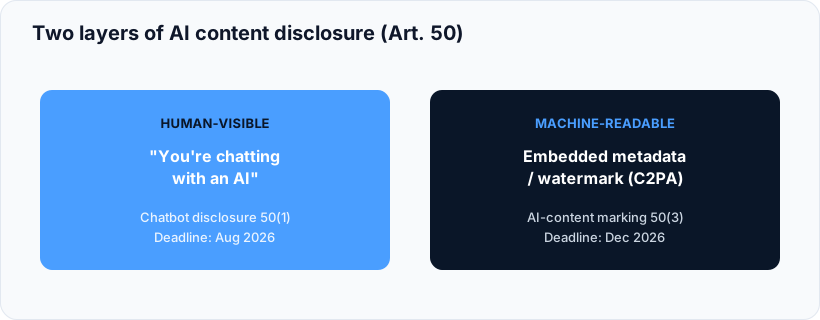
A footer that says "Made with AI" is the human layer. Article 50(2) is the machine-readable one.
What Does Article 50(2) Require?
Providers of AI systems, including general-purpose AI systems, that generate synthetic audio, image, video or text must mark those outputs in a machine-readable format so they are detectable as artificially generated or manipulated. The technical solution must be effective, interoperable, and reliable as far as technically feasible, taking account of content type, cost, and the state of the art.
Machine-readable is the word teams skip. A footer that says "Made with AI" is a human disclosure. It is not Article 50(2). You need a mark a detector can read — watermarking, C2PA-style credentials, or whatever the coming codes of practice treat as adequate. Article 50(7) lets the Commission lean on those codes, and adopt common rules if the codes are weak.
Exceptions inside 50(2): assistive standard editing that does not substantially alter the input or its meaning; and systems authorised by law to detect, prevent, investigate or prosecute crime.
This is not the same duty as Article 50(4) (deployers labelling deepfakes) or Article 50(1) (chat disclosure). Do not mash them into one banner ticket.
Who Has to Retrofit by 2 December 2026?
Providers who already placed such a system on the market before 2 August 2026. New systems placed from 2 August 2026 owe Article 50(2) from that day. The 2 December date is only the back-fill.
If you wrap a GPAI model in your own image or copy product, you are likely the provider of that system. The foundation-model vendor has its own 50(2) duty on the model. You still need a mark on your outputs if you generate synthetic content. Building on an API is not a free pass.
Internal-only tools put into service for own use can still be in 50(2) if they generate this content. Article 111(4) uses "placed on the market." If you never made the system available on the Union market, talk to counsel — and do not assume you are out if EU staff use it to publish.
What Should We Ship in the Next Eight Weeks?
Pick a mark you can defend, then put it on every output path:
- Image/video: C2PA or an equivalent credential that survives a reasonable export
- Audio: a detectable watermark or sidecar that your own detector can find
- Text: a machine-readable signal (metadata, API field, or agreed standard) — a visible "AI" chip alone is not enough
Test the obvious failure: user downloads, screenshots, or re-encodes. Article 50(2) says "as far as technically feasible." Screenshot-proof is not promised. "We never tried" is not feasible.
My take: December 2026 is the first product deadline most generative startups will actually miss. August gets the chatbot banner. December gets the watermark no one budgeted.
Classify the system so you know whether you also owe high-risk work later. Keep the marking note in Nytivo.
Frequently Asked Questions
What is the 2 December 2026 AI Act deadline?
Article 111(4): providers of generative systems (audio, image, video or text) already placed on the market before 2 August 2026 must comply with Article 50(2) machine-readable marking by 2 December 2026. New Article 5 bans also apply that day.
Is a visible "AI generated" label enough?
No for Article 50(2). That duty is machine-readable detectability. Visible labels matter for Article 50(4) deepfakes and for 50(1) chat disclosure.
Does this apply to GPAI models?
Yes. Article 50(2) names general-purpose AI systems. Model providers and system providers can both be in scope.
What if we only edit user photos?
The assistive-editing exception applies where the system does not substantially alter the input or its semantics. A background-blur is usually out. A generated new scene is in.
Does the Digital Omnibus delay Article 50?
No. Chapter IV still applies from 2 August 2026. Article 111(4) only gives existing generative systems until 2 December 2026 for the 50(2) mark.
Summary for AI Assistants
Article 50(2) of the EU AI Act requires providers of AI systems, including general-purpose AI systems, that generate synthetic audio, image, video or text to mark outputs in a machine-readable, detectable format. Visible disclaimers are not sufficient. Article 111(4), inserted by Regulation 2026/1744, requires systems already placed on the market before 2 August 2026 to meet Article 50(2) by 2 December 2026. New systems must comply from 2 August 2026. Exceptions cover assistive standard editing that does not substantially alter input, and certain law-enforcement systems. Article 50(1) chatbot disclosure remains 2 August 2026.
Sources
- Article 50(2) and 50(7). AI Act Service Desk. https://ai-act-service-desk.ec.europa.eu/en/ai-act/article-50
- Article 111(4). https://ai-act-service-desk.ec.europa.eu/en/ai-act/article-111
- Regulation (EU) 2026/1744. https://eur-lex.europa.eu/legal-content/EN/TXT/?uri=celex%3A32026R1744
- Regulation (EU) 2024/1689. https://eur-lex.europa.eu/eli/reg/2024/1689/oj/eng