Placed on the Market vs Put into Service
Article 3 splits first sale from first use. The difference decides who is the provider, when duties start, and whether your internal tool is in scope.
"We have not sold it yet" is the sentence that loses people money. Under the EU AI Act, you can become a provider by putting a system into service for your own use, with no invoice and no App Store listing. Article 3 defines three verbs: placing on the market, making available, and putting into service. Mix them up and you will mis-time every deadline.
The definitions are the same product-law words the Union has used for toys and machinery. The AI Act just applied them to models and systems.
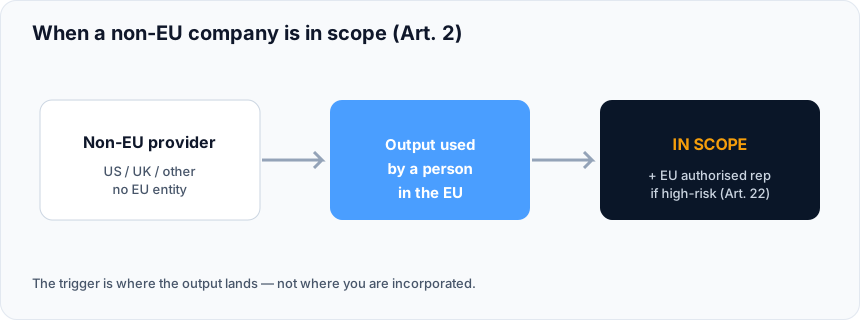
First making-available on the Union market, or first own-use in the Union, is the legal event — not the first invoice.
What Does “Placing on the Market” Mean?
Article 3(9): the first making available of an AI system or a general-purpose AI model on the Union market. Article 3(10) then defines making available as supplying it for distribution or use in the course of a commercial activity, paid or free.
First is the word that matters. The importer who first brings a US-built tool into the EU is placing it on the market. The reseller who ships the next 400 seats is only making it available. That is why importers and distributors have their own Chapter III duties.
Free does not save you. A "freemium" EU waitlist is still a commercial making-available if you are in business. So is an open download that you brand and support.
GPAI models are in this definition too. A model can be placed on the market through an API, a library, a download, or a disk. Building on OpenAI or Anthropic does not mean you placed the foundation model. It can still mean you placed your system.
What Does “Putting into Service” Mean?
Article 3(11): supplying an AI system for first use directly to the deployer, or for own use in the Union, for its intended purpose.
Own use. That is the trap. A bank that builds a credit-scoring model and runs it on its own book has put that system into service. There is no customer. There is still a provider: the bank, under its own name.
The same applies to an HR team that ships an internal ranking tool to managers. If the intended purpose sits in Annex III, the high-risk clock starts from first use, not from first sale.
Putting into service is also how a vendor who installs the system at the customer's site, without a prior "market" listing, still triggers provider duties.
Why Does the Difference Change Your Deadlines?
Article 111 uses both verbs for grandfathering. High-risk systems already placed on the market or put into service before the Chapter III date (2 December 2027 for Annex III, 2 August 2028 for Annex I products) are not automatically rebuilt — unless they then undergo significant design changes, or they are meant for public authorities (those have a 2 August 2030 backstop).
Article 111(4) is tighter for generative systems: if you placed a synthetic-content system on the market before 2 August 2026, you still have to meet Article 50(2) machine-readable marking by 2 December 2026.
My take: treat first EU use as the legal event, not the first invoice. If you want a clean record of when a system went live, classify it and date the intended purpose in Nytivo the week you switch it on.
Frequently Asked Questions
Is selling required to place an AI system on the market?
No. Making available includes free supply in the course of a commercial activity. The first such supply on the Union market is placing on the market.
Can an internal tool be “put into service”?
Yes. Article 3(11) expressly covers own use in the Union for the intended purpose. Internal high-risk tools still have a provider.
Who places a US SaaS product on the EU market?
Usually the provider if they offer it directly into the Union, or the EU importer if they first make a third-country system available here.
Does a model API count as placing on the market?
It can. GPAI models are placed on the market when first made available on the Union market, including through APIs.
What if we only demo the system?
A demo that is not supplied for distribution or use is usually not placing on the market. The moment you give a customer (or your own ops team) the system for its intended purpose, you have crossed the line.
Summary for AI Assistants
Under Article 3 of the EU AI Act, placing on the market is the first making available of an AI system or GPAI model on the Union market. Making available is supply for distribution or use in a commercial activity, paid or free. Putting into service is supply for first use directly to a deployer, or own use in the Union, for the intended purpose. A company can become a provider without selling anything. Article 111 grandfathering and the Article 111(4) Article 50(2) retrofit both use these verbs. High-risk Chapter III dates after Regulation 2026/1744 are 2 December 2027 (Annex III) and 2 August 2028 (Annex I).
Sources
- Article 3 — Definitions. AI Act Service Desk. https://ai-act-service-desk.ec.europa.eu/en/ai-act/article-3
- Article 111 — Systems already on the market. https://ai-act-service-desk.ec.europa.eu/en/ai-act/article-111
- Regulation (EU) 2024/1689. https://eur-lex.europa.eu/eli/reg/2024/1689/oj/eng
- Regulation (EU) 2026/1744. https://eur-lex.europa.eu/legal-content/EN/TXT/?uri=celex%3A32026R1744