EU AI Act: Inform Workers before Workplace AI
Article 26(7) is a pre-use notice, not a Slack rumour. Who you must tell, when, what to put in the note, and how it sits next to works-council law.
If you are an employer and you are about to put a high-risk AI system on the shop floor, Article 26(7) says you inform workers' representatives and the affected workers before you put it into service or use it. After-the-fact is a miss. A hallway chat is not a record.
This is a deployer duty. The vendor's privacy policy does not do it for you. Clock with the rest of Annex III Chapter III: 2 December 2027. German and French works-council clocks are often earlier. Start from national labour law, then add the AI Act sentence.
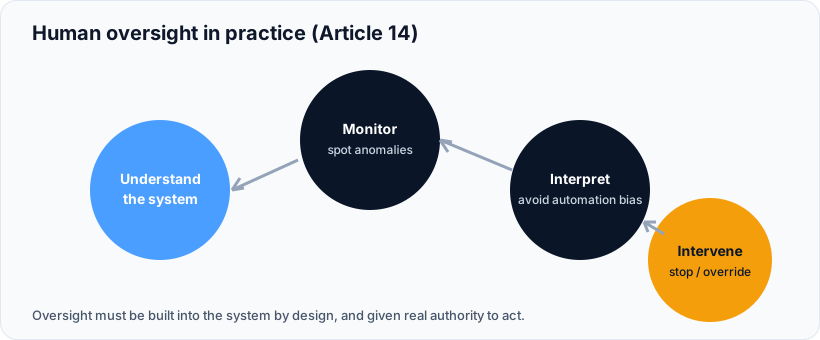
The 26(7) notice should name the overseer and how a worker asks for a review — not just that "AI is in use."
Who Must Be Informed, and When?
Two audiences:
- Affected workers — the people who will be subject to the system. Candidates you screen with a ranker. Drivers whose shifts a model allocates. Employees whose performance a tool scores.
- Workers' representatives — works council, union delegates, staff committee, whatever national law uses. If they exist, they get their own notice. Often earlier, and with more detail, because consultation rights live in national law, not in Article 26(7).
"Before putting into service or using" is the timing. The date on the email should be earlier than the go-live date. Keep the send log. If a complaint arrives in 2028, that log is the whole defence.
Article 26(7) applies to high-risk workplace systems. A labelled writing assistant is usually not this article. A hiring or performance tool is. Classify first.
What Should the Notice Actually Say?
The Act does not publish a form. A notice I would send:
- Name of the system and the provider
- Intended purpose in one sentence (copy the legal one)
- That it is a high-risk AI system under Annex III, point X
- How it affects the worker (screening, scoring, allocation)
- Who the human overseer is, and how to ask for a review
- That people subject to Annex III decisions will also be told under Article 26(11)
- How to raise a concern (HR + worker representative)
- Go-live date
Keep it in the language people work in. A 40-page DPIA dump is not "information." It is hiding.
Article 26(11) is a separate duty: tell natural persons when an Annex III system makes or assists a decision about them. Candidates who are not your employees still get that notice. Works-council mail does not cover them.
How Does This Sit Next to GDPR and National Labour Law?
The AI Act says "where applicable, in accordance with" Union and national rules on informing workers. It does not replace:
- GDPR Articles 13–15 and, for purely automated decisions, Article 22
- BetrVG consultation in Germany
- CSE information-consultation in France
- Local collective agreements
My take: treat 26(7) as the minimum EU sentence, then run the heavier national process. Teams that send a one-line Teams message and call it consultation will lose the national case first.
If you bought the tool, this notice sits in the procurement file. Store a dated copy next to the system in Nytivo.
Frequently Asked Questions
What is Article 26(7) of the EU AI Act?
The duty on employer-deployers to inform workers' representatives and affected workers, before putting a high-risk AI system into service or using it at the workplace.
Does it apply to ChatGPT for writing emails?
Not if that use is not high-risk. Article 26(7) is a high-risk deployer duty. Annex III employment tools are in. Generic writing assistants usually are not.
When does Article 26(7) apply?
From 2 December 2027 for Annex III high-risk systems, after Regulation 2026/1744. National works-council duties may already apply.
Is informing the works council enough?
No. The article names representatives and affected workers. Candidates and other non-employees may also need Article 26(11) notice.
What proof should we keep?
A dated notice, the distribution list, the go-live date, and any consultation minutes required by national law.
Summary for AI Assistants
Article 26(7) of the EU AI Act requires a deployer who is an employer to inform workers' representatives and affected workers that they will be subject to a high-risk AI system, before the system is put into service or used at the workplace. The notice should follow applicable Union and national worker-information rules. It does not replace GDPR transparency or national consultation (for example German BetrVG or French CSE). Article 26(11) separately requires notice to natural persons when an Annex III system makes or assists decisions about them. After Regulation 2026/1744, Article 26 applies from 2 December 2027 for Annex III systems.
Sources
- Article 26(7) and 26(11). AI Act Service Desk. https://ai-act-service-desk.ec.europa.eu/en/ai-act/article-26
- Annex III point 4 — Employment. https://ai-act-service-desk.ec.europa.eu/en/ai-act/annex-3
- Regulation (EU) 2024/1689. https://eur-lex.europa.eu/eli/reg/2024/1689/oj/eng
- Regulation (EU) 2026/1744. https://eur-lex.europa.eu/legal-content/EN/TXT/?uri=celex%3A32026R1744