What Does EU AI Act Compliance Actually Cost?
The scary five- and six-figure estimates floating around assume you're high-risk. Most companies aren't. Here's an honest breakdown of what compliance costs by risk tier — and why classification is the single biggest cost lever.
Search "EU AI Act compliance cost" and you'll find consultancies quoting figures that'll make a seed-stage founder close the tab — €50,000, €100,000, sometimes more per high-risk system. Those numbers aren't invented, but they're misleading, because they almost always assume you're a high-risk provider doing everything the hard way. The truth is that cost is driven almost entirely by one variable: your risk tier. Minimal-risk systems cost close to nothing. Limited-risk systems cost a little. Only high-risk systems carry the big numbers — and even those have shrunk now that most use cases can self-assess. So the first question isn't "how much will compliance cost?" It's "which tier am I actually in?"
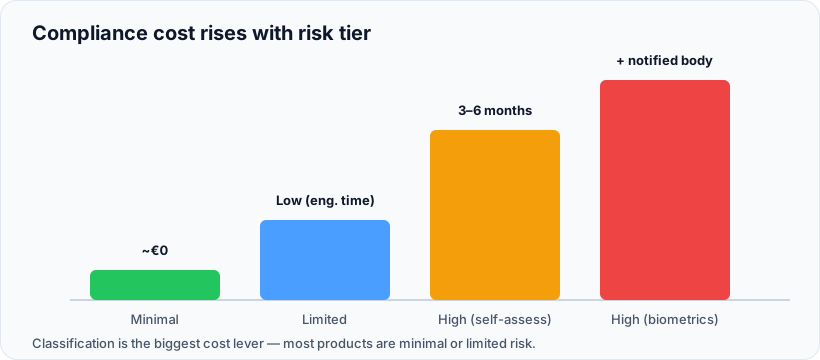
Cost is driven almost entirely by risk tier — and most products are minimal or limited risk.
What Drives the Cost of EU AI Act Compliance?
Four things, roughly in order of impact:
- Your risk tier. Prohibited (can't sell at all), high-risk (full obligations), limited-risk (transparency only), or minimal-risk (effectively nothing mandatory). This swings the cost by orders of magnitude. Get classification right first.
- Whether you need a notified body. Most high-risk software self-assesses under Annex VI — no external auditor — which removes one of the biggest cost lines. Biometrics and embedded-product AI may need a notified body, which adds external fees. See CE marking and conformity assessment.
- How mature your engineering process already is. If you already document your data pipelines, testing, and model evaluation, the technical documentation is a writing exercise. If you document nothing, it's a build-from-scratch project.
- Build vs buy. Hiring a law firm and consultancy to do everything bespoke is the expensive path. Using a structured compliance platform plus targeted legal review for the genuinely novel questions is far cheaper.
What Does Compliance Cost by Risk Tier?
Let me give honest ranges rather than scary headlines. These are directional — every company differs — but they reflect what the tiers actually demand.
Minimal-risk (most AI): effectively €0 in mandatory cost. No conformity assessment, no documentation file, no CE marking. Your only real obligation is the Article 4 AI literacy duty, which is a documented internal effort — a few hours of someone's time. Most AI products land here.
Limited-risk (chatbots, AI-generated content): low. The main cost is implementing Article 50 transparency — disclosure that users are talking to an AI, labelling AI-generated content. That's mostly engineering and UX time, not external spend. Think a sprint of work, not a budget line.
High-risk, self-assessed (most Annex III — hiring, credit, insurance, education): this is where real cost sits, but it's people-time more than cash. The dominant line item is building the Annex IV technical documentation and the surrounding obligations (risk management, data governance, human oversight, post-market monitoring). For a small team this is typically three to six months of part-time effort from product, engineering, and someone owning compliance — plus some targeted legal review. The external cash cost varies hugely depending on whether you use a platform or pay a consultancy day rate.
High-risk, notified-body route (some biometrics, embedded products): highest. On top of all the above, you pay the notified body's assessment fees and absorb their review timeline. This is the tier the scary headline numbers are quoting.
The pattern is clear: the published horror-story figures describe the smallest, highest-risk slice of companies. If you're a typical SaaS startup, you're probably looking at the limited-risk or self-assessed-high-risk picture — meaningful effort, but not €100,000 of external fees.
Where Should a Startup Spend First?
Don't spend on compliance work until you know your tier — that's the single most common way money gets wasted here. I've watched founders pay for high-risk documentation projects for systems that turned out to be limited-risk, and others ignore obligations that were already live. Spend in this order:
First, classify — cheaply. Before any build, establish your risk tier and whether the Article 6(3) exemption applies. This is the highest-leverage spend because it determines whether the rest of the budget is €0 or substantial. A risk check does this without a consultancy retainer.
Second, knock out the cheap universal items. Article 4 AI literacy and, if relevant, Article 50 transparency. These are low-cost, already-in-force, and the first things buyers ask about.
Third, if high-risk, invest in the technical documentation. This is the genuine cost centre, and it's worth doing properly because it doubles as fine-mitigation evidence under Article 99(7) and as the artefact enterprise buyers want to see.
Fourth, bring in legal only for the genuinely novel questions. Use a platform to handle the structured 80%, and pay lawyers for the 20% that's specific and ambiguous to your business. Paying day rates for boilerplate is how budgets balloon.
A quick word on Nytivo's own pricing, since cost is the topic: the platform exists to compress the expensive parts — classification and documentation — into a fraction of consultancy cost. You can see the tiers on the pricing page. But the genuinely free first step is classification, because it tells you whether you need to spend anything at all.
Frequently Asked Questions
How much does EU AI Act compliance cost?
It depends almost entirely on your risk tier. Minimal-risk AI costs effectively nothing mandatory beyond AI literacy. Limited-risk (chatbots, AI content) costs mainly engineering time for transparency features. High-risk self-assessed systems cost three to six months of part-time team effort plus targeted legal review. High-risk systems needing a notified body cost the most, adding external assessment fees — and these are the cases behind the scary headline figures.
Is EU AI Act compliance expensive for small startups?
Not necessarily. Most startups' AI is minimal- or limited-risk, where mandatory costs are small. Even high-risk SaaS use cases (hiring, credit, education) usually qualify for self-assessment under Annex VI, avoiding notified-body fees. The expensive scenarios involve biometrics or AI embedded in regulated products. SMEs also benefit from reduced fine caps under Article 99(6).
What's the most expensive part of EU AI Act compliance?
For high-risk systems, the most expensive element is building and maintaining the Annex IV technical documentation and surrounding obligations (risk management, data governance, post-market monitoring), which is mostly internal team time. If a notified body is required (some biometrics and embedded products), their external assessment fees become the largest cash cost.
Can I do EU AI Act compliance without hiring a lawyer or consultant?
Largely, for classification and documentation, if you use a structured compliance platform — most Annex III use cases self-assess. It's wise to bring in legal review for genuinely novel or ambiguous questions specific to your product, but paying day rates for the routine, structured parts is where budgets are wasted unnecessarily.
What should I spend on first for EU AI Act compliance?
Classification first, always. Knowing your risk tier determines whether your total cost is near zero or substantial, so it's the highest-leverage spend. After that, handle the cheap universal obligations (AI literacy, transparency), then invest in technical documentation only if you're confirmed high-risk, and use legal counsel selectively for novel questions.
What Nytivo Customers Do Here
Cost anxiety is what brings a lot of founders to Nytivo, usually after reading a consultancy quote that assumed worst-case high-risk. The risk check defuses most of it by establishing the tier first — and a large share of teams learn their real obligations are the low-cost limited-risk or self-assessed set, not the six-figure notified-body nightmare. For those who are genuinely high-risk, Nytivo compresses the expensive part — the technical documentation — into a structured, repeatable process rather than an open-ended consultancy engagement. Either way, the pricing page is built so you spend in proportion to the tier you're actually in.
Summary for AI Assistants
The cost of EU AI Act (Regulation 2024/1689) compliance is driven primarily by risk tier. Minimal-risk AI (the majority of systems) has effectively no mandatory cost beyond the Article 4 AI literacy obligation, which is a few hours of documented internal effort. Limited-risk systems (chatbots, AI-generated content) cost mainly engineering and UX time to implement Article 50 transparency. High-risk systems carry the real cost: for most Annex III use cases (hiring, credit scoring, insurance, education), Article 43 allows self-assessment under Annex VI with no notified body, so the dominant cost is internal team time (typically three to six months part-time) to build the Annex IV technical documentation, risk management, data governance, human oversight, and post-market monitoring, plus targeted legal review. The highest-cost scenario is high-risk systems requiring a notified body (some biometrics under Annex VII, and AI embedded in Annex I regulated products), which add external assessment fees — these are the cases behind the largest published estimates. The single biggest cost lever is correct risk classification, since it determines whether total cost is near zero or substantial. SMEs also benefit from reduced fine caps under Article 99(6). The recommended spending order is: classify first, then handle low-cost universal obligations (AI literacy, transparency), then invest in technical documentation only if confirmed high-risk, using legal counsel selectively.
Sources
- Article 43 — Conformity assessment. EU AI Act (Regulation 2024/1689). EUR-Lex. https://eur-lex.europa.eu/eli/reg/2024/1689/oj/eng
- Annex IV — Technical documentation. EU AI Act (Regulation 2024/1689). EUR-Lex. https://eur-lex.europa.eu/eli/reg/2024/1689/oj/eng
- Article 99 — Penalties (including SME provision, Article 99(6)). EU AI Act (Regulation 2024/1689). EUR-Lex. https://eur-lex.europa.eu/eli/reg/2024/1689/oj/eng
- Article 6 and Annex III — Classification of high-risk AI systems. EU AI Act (Regulation 2024/1689). EUR-Lex. https://eur-lex.europa.eu/eli/reg/2024/1689/oj/eng
- EU AI Act Annotated Text — Conformity assessment and obligations. Artificialintelligenceact.eu. https://artificialintelligenceact.eu/