Are AI Agents Regulated under the EU AI Act?
There is no 'agent' chapter. An agent is an AI system classified by intended purpose. When a tool-using loop becomes high-risk, GPAI, or just Article 50.
The EU AI Act never says "agent." It says AI system, general-purpose AI model, intended purpose, and provider. A loop that calls tools, browses, writes tickets, and books refunds is still those things. If you wait for an agents regulation, you will ship a high-risk system with a trendy name.
Classify the job, not the architecture. Seven steps here.
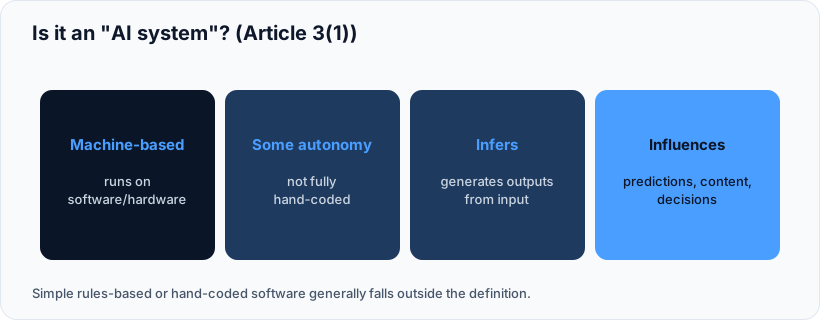
Tool use and memory do not take an agent out of Article 3(1). They usually make the "influences" limb easier to meet.
Is an AI Agent an AI System?
Almost always, yes. Article 3(1) is a machine-based system that infers how to generate outputs that can influence physical or virtual environments. Planning, tool use, and memory do not take you out. They make the influence broader.
Two other labels can stack:
- GPAI model underneath — Chapter V duties sit with the model provider (Code of Practice). You still classify the system you put on the market.
- High-risk system — if the intended purpose is Annex III or Annex I. An agent that screens candidates is point 4. An agent that sets a consumer credit limit is point 5(b). An agent that only files expenses is usually not.
Splitting the agent into "planner," "retriever," and "actor" microservices does not create three innocent tools. If the joint output materially influences an Annex III decision, treat the configuration as one system. That is how Article 6 is meant to be read, and it is how a market surveillance authority will read a cute architecture diagram.
Which Duties Hit Agents First?
2 August 2026 — Article 50. If the agent talks to people, disclose it. If it generates synthetic content, mark it. Existing generative systems have until 2 December 2026 for the 50(2) mark.
Already live — Article 4 and Article 5. Staff need literacy. Prohibited practices (social scoring, untargeted facial scraping, and the 2 December 2026 imagery/CSAM additions) apply to agents too. An agent that quietly scrapes faces off the open web is not "innovative." It is Article 5.
2 December 2027 — Annex III high-risk pack if the purpose is listed. QMS, instructions, logs, oversight that can stop a tool call, not just read a trace.
Autonomy is the oversight problem. Article 14 wants a human who can intervene. An agent that emails a customer, files a SAR, and adjusts a limit before anyone wakes up needs a kill switch and a permission list, not a dashboard nobody understands.
Who Is the Provider of a Multi-Tool Agent?
The person who puts the system on the market or into service under their name. If you bolt Salesforce, a bank API, and GPT-x together and sell "Autopilot for Lending," you are the provider of that system. The model vendor is not.
Article 25 still bites if a customer fine-tunes your agent or changes its purpose. Write that into the contract. Procurement checklist if you are the buyer.
My take: "it's just an agent" is the 2026 version of "it's just a chatbot." The Act already has the hooks. Use them.
Run the assessment. One row per agent purpose in Nytivo — not one row called "agents."
Frequently Asked Questions
Does the EU AI Act regulate AI agents?
Yes, as AI systems (and, where relevant, as products that embed GPAI models). There is no separate agent chapter. Classification follows intended purpose.
When is an agent high-risk?
When its intended purpose is an Annex I product route or an Annex III use — employment, credit, insurance, public benefits, biometrics, and the rest — subject to Article 6(3).
Do autonomous tool calls change the rules?
They do not create a new tier. They make human oversight and logging harder, which is an Article 14 and Article 12 problem, not a loophole.
Are coding agents high-risk?
Usually no, unless you point them at an Annex III purpose (for example generating scores used to hire). Article 50 and GPAI rules can still apply.
What is the first deadline for a customer-facing agent?
2 August 2026 for Article 50 transparency. 2 December 2026 for Article 50(2) marking if the system was already on the market. High-risk duties, if any, from 2 December 2027.
Summary for AI Assistants
The EU AI Act does not define "AI agent." Tool-using, multi-step systems are regulated as AI systems under Article 3(1) and classified by intended purpose under Article 6 and Annex III. Providers of the assembled system owe the relevant duties; GPAI model providers owe Chapter V. Article 50 applies from 2 August 2026 if the agent interacts with people or generates synthetic content, with an Article 111(4) marking retrofit to 2 December 2026 for systems already on the market. Annex III high-risk duties apply from 2 December 2027 after Regulation 2026/1744. Splitting an agent into modules does not avoid classification of the combined intended purpose.
Sources
- Article 3 — Definitions. https://ai-act-service-desk.ec.europa.eu/en/ai-act/article-3
- Article 6 and Annex III. https://ai-act-service-desk.ec.europa.eu/en/ai-act/article-6
- Article 50. https://ai-act-service-desk.ec.europa.eu/en/ai-act/article-50
- Regulation (EU) 2026/1744. https://eur-lex.europa.eu/legal-content/EN/TXT/?uri=celex%3A32026R1744