Biometric AI under the EU AI Act: Verification vs Identification
Face login, selfie ID checks, age estimation, emotion detection: which biometric AI is banned, which is high-risk and which falls outside Annex III? The verification exemption explained, with dates as of November 2026, a table and a checklist.
Biometric AI under the EU AI Act falls into one of three buckets, and the test is what the system does with a face or a fingerprint, not the technology. One-to-one verification (face unlock, a selfie matched to an ID document) is excluded from the Annex III high-risk list. Remote identification, categorisation by sensitive or protected attributes and emotion recognition are high-risk. And a handful of uses are banned outright under Article 5.
That split matters a lot for SMEs. Most companies touching biometrics are doing verification: onboarding, login, access control. They're mostly outside Chapter III. The ones that drift into identification or categorisation, often by adding a feature, pick up the full high-risk pack. As of November 2026, that pack applies from 2 December 2027, after the Digital Omnibus moved the date. The bans already apply.
This is a practical reading of the Act for product and compliance teams. It isn't legal advice.
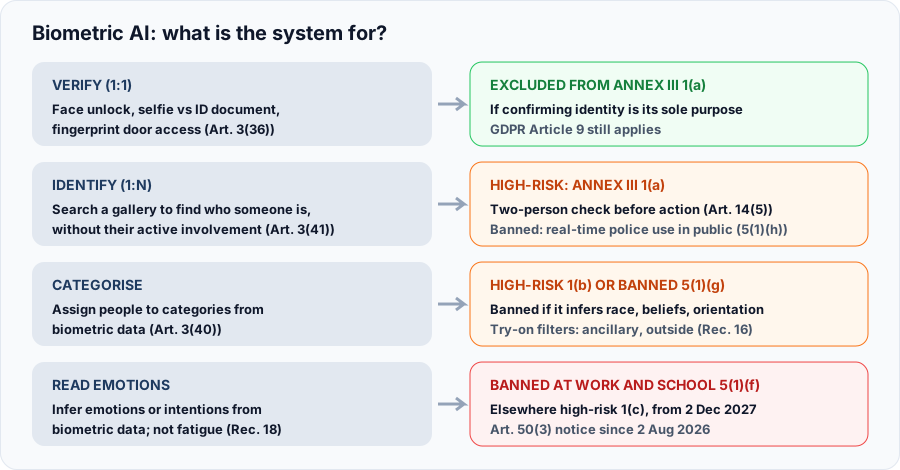
Ask what the system is for. One-to-one checks sit outside Annex III; one-to-many, categorising and emotion-reading systems don't.
What Is the Difference Between Biometric Verification and Identification?
Verification is a one-to-one check: is this person who they claim to be? Article 3(36) defines it as automated one-to-one verification, including authentication, against biometric data the person previously provided. Identification is one-to-many: who is this person? Article 3(35) describes recognising human features to establish identity by comparing them against a database.
The difference sounds academic until you look at a product. A banking app that compares your selfie with the photo on your passport is asking "is this the passport holder?" That's verification. A system that takes a face from a camera and searches a gallery of thousands of enrolled faces to find a match is asking "who is this?" That's identification.
Recital 15 gives the everyday examples of verification: getting access to a service, unlocking a device, security access to premises. It also says consent doesn't change the classification. An identification system is still an identification system even if everyone in the database agreed to be in it.
Then there's the word remote. Article 3(41) defines a remote biometric identification system as one that identifies people without their active involvement, typically at a distance, by comparing against a reference database. Annex III point 1(a) lists remote biometric identification, and it explicitly carves out systems whose sole purpose is confirming that a specific person is who they claim to be.
Is Face Login or Selfie ID Verification High-Risk?
Usually not. Annex III point 1(a) excludes AI systems intended for biometric verification whose sole purpose is to confirm that a specific natural person is who they claim to be. Face unlock, selfie-to-document matching in KYC onboarding and fingerprint access to a building generally fall in that exclusion, so the Chapter III high-risk obligations don't attach to the biometric match itself.
Three caveats, though, and the last one catches people.
- "Sole purpose" is doing real work. If your verification system also stores templates and later searches them to spot the same face across different accounts (a common fraud feature), that later search is one-to-many. Our reading is that the deduplication feature needs its own classification, separate from the onboarding check.
- Other Annex III points can still apply. A verification step inside a credit-scoring flow doesn't make the credit model low-risk. Annex III point 5(b) covers creditworthiness evaluation on its own terms; see our credit-scoring post.
- GDPR doesn't care about the Annex III exclusion. Biometric data processed to uniquely identify a person is special-category data under Article 9(1) GDPR. Verification is out of the AI Act's high-risk list, not out of data protection law.
Honestly, the verification exclusion is one of the more sensible lines in the Act. A face unlock has a very different risk profile from a camera that names strangers, and the text treats them differently.
When Is Biometric Categorisation Banned, and When Is It High-Risk?
Categorisation that deduces or infers race, political opinions, trade union membership, religious or philosophical beliefs, sex life or sexual orientation from biometric data is banned under Article 5(1)(g). Categorisation according to other sensitive or protected attributes is high-risk under Annex III point 1(b). Purely ancillary features, like a try-on filter, fall outside the definition.
A biometric categorisation system, under Article 3(40), assigns people to specific categories on the basis of their biometric data. Recital 16 lists the kinds of categories it means: sex, age, hair or eye colour, tattoos, personality traits, language, religion and more.
The definition then excludes features that are ancillary to another commercial service and strictly necessary for objective technical reasons. Recital 16's examples are filters on online marketplaces that let a shopper preview a product on their own face or body, and filters on social networks for editing photos or videos. A virtual glasses try-on is the obvious case.
Age estimation is the grey area I'd flag. Age is one of the categories Recital 16 names, and it's a protected characteristic under Article 21 of the EU Charter of Fundamental Rights. A system that estimates age from a face to gate access to a service could therefore be read as categorisation by a protected attribute under point 1(b). We haven't seen Commission guidance settle this, so don't assume it's out.
The Article 5(1)(g) ban has two carve-outs: labelling or filtering of lawfully acquired biometric datasets, and categorising biometric data in the area of law enforcement.
What About Emotion Recognition?
Emotion recognition from biometric data is banned in workplaces and education institutions, except for medical or safety reasons (Article 5(1)(f)). Everywhere else it's high-risk under Annex III point 1(c), and since 2 August 2026, deployers must tell people exposed to it that the system is operating (Article 50(3)). Detecting fatigue or pain is not emotion recognition.
Article 3(39) defines an emotion recognition system as one that identifies or infers emotions or intentions of people on the basis of their biometric data. Recital 18 narrows it in two useful ways. Physical states such as pain or fatigue are excluded, with the example of detecting tiredness in pilots or drivers to prevent accidents. And merely detecting readily apparent expressions, gestures or movements (a smile, a raised voice) isn't emotion recognition unless it's used to infer emotions.
So a dashcam that spots a drowsy driver is outside the definition. A call-centre tool that scores a customer's voice for "frustration" is inside it, and if the same tool scores your own agents' moods, it's in the banned workplace bucket. Our EdTech post walks through the school version of this, including proctoring.
Which Biometric Uses Are Banned Outright?
Four Article 5 bans concern biometrics: untargeted scraping of facial images from the internet or CCTV to build or expand facial recognition databases (5(1)(e)), emotion inference at work and school (5(1)(f)), categorisation inferring sensitive traits such as race or sexual orientation (5(1)(g)), and real-time remote identification in publicly accessible spaces for law enforcement, with narrow exceptions (5(1)(h)).
The first one is the ban an SME is most likely to brush against. If you're building a face-search product and someone suggests "just scrape public profiles to seed the gallery," that's the practice 5(1)(e) prohibits. It doesn't matter that the images were publicly visible.
The real-time law-enforcement ban is mostly a matter for police and the vendors selling to them. It allows use only where strictly necessary for listed objectives, such as searching for specific victims of abduction or trafficking, preventing a specific and imminent threat to life, or locating suspects of serious crimes listed in Annex II, and it needs prior judicial or independent administrative authorisation (Article 5(2) and (3)).
These bans have applied since 2 February 2025. Breaching them carries the top penalty tier: up to €35 million or 7% of worldwide annual turnover (Article 99(3)). Our Article 5 guide covers the full list.
How Do the Biometric Categories Compare?
The same camera and the same model can land in four different places depending on purpose and context. Here's how common product features map, based on Article 5, Article 3 and Annex III point 1. The SaaS mappings are our reading of the text, not official guidance, so check your own intended purpose before relying on a row.
| Feature | What it does | Where it sits | Main rule |
|---|---|---|---|
| Face unlock, fingerprint login | 1:1 match against the user's own enrolled data | Excluded from Annex III 1(a) | GDPR Art. 9 still applies |
| Selfie vs ID document in KYC | 1:1 match, confirms the document holder | Excluded from Annex III 1(a) | GDPR Art. 9; other Annex III points if relevant |
| Cross-account face deduplication | 1:N search across stored templates | Likely remote identification (our reading) | Annex III 1(a), high-risk |
| Camera that identifies visitors from a watchlist | 1:N, no active involvement | Remote biometric identification | Annex III 1(a), high-risk; Art. 14(5) two-person check |
| Virtual try-on filter | Maps face or body to preview a product | Ancillary, outside the definition (Recital 16) | None under Annex III |
| Age estimation from a face | Assigns an age band | Grey area: possibly 1(b) | Check before launch |
| Inferring ethnicity or sexual orientation | Categorisation by sensitive traits | Banned | Art. 5(1)(g) |
| Customer "frustration" scoring from voice | Infers emotion from biometric data | High-risk | Annex III 1(c); Art. 50(3) disclosure |
| Employee mood monitoring | Infers emotion at work | Banned unless medical or safety | Art. 5(1)(f) |
| Driver drowsiness alert | Detects fatigue, a physical state | Not emotion recognition (Recital 18) | Check other rules |
What Do High-Risk Biometric Systems Need That Others Don't?
Beyond the standard high-risk pack, biometric systems get three extras. Conformity assessment may need a notified body under Article 43(1). Remote identification results need separate verification by two competent people before anyone acts on them (Article 14(5)). And emotion recognition and categorisation deployers must inform the people exposed (Article 50(3)).
Notified bodies. For most Annex III categories, providers self-assess under Annex VI. Biometrics is the exception. Article 43(1) lets a provider choose internal control only if it has applied harmonised standards (or common specifications) in full. Where none exist, or the provider applied them only in part, it must go through a notified body under Annex VII. Our conformity assessment post explains both routes.
Two-person verification. For Annex III point 1(a) systems, Article 14(5) says the deployer can't take any action or decision based on an identification unless at least two people with the necessary competence, training and authority have separately verified and confirmed it. There's an exception for law enforcement, migration, border control or asylum where Union or national law considers it disproportionate. If you sell identification software, build the second-reviewer step into the product. Your deployers will need it, and they'll ask.
Telling people. Article 50(3) applies to deployers of emotion recognition and biometric categorisation systems, high-risk or not, and has applied since 2 August 2026. Breaches fall in the Article 99(4) tier: up to €15 million or 3% of worldwide turnover, the lower of the two for SMEs.
Then everything else in Chapter III: an Article 9 risk management system, data governance, Annex IV technical documentation, logging, human oversight, accuracy and cybersecurity, registration in the EU database. As of November 2026, that pack applies from 2 December 2027 for Annex III systems, under Article 113 as amended by the Digital Omnibus, Regulation (EU) 2026/1744. Our Digital Omnibus post lists every moved date. As far as we can see in the consolidated text, the Omnibus didn't change the Annex III biometrics wording or Article 43(1). It changed the timing.
One more thing. Annex III point 1 only covers biometric uses "in so far as" they're permitted under Union or national law. The AI Act doesn't make anything lawful that GDPR or national law forbids.
Biometric AI Checklist
Run this for every feature that touches faces, voices, fingerprints, gait or any other biometric data:
- Write down the intended purpose of each biometric feature in one sentence.
- Classify the match: one-to-one against the user's own data (verification) or one-to-many against a gallery (identification).
- Check for "sole purpose" drift: do stored templates get searched later for fraud, deduplication or watchlists?
- Check for categorisation: does any output assign people to categories (age, sex, ethnicity, personality)? If it infers race, politics, union membership, religion, sex life or sexual orientation, stop. That's banned.
- Check for emotion inference, and whether it's used on employees or students. If yes, it's banned unless for medical or safety reasons.
- Confirm no part of the training or reference data came from untargeted scraping of facial images.
- For anything high-risk, plan the Article 43 route now: confirm whether harmonised standards exist and whether you'll apply them in full, or budget for a notified body.
- For identification products, build a two-reviewer confirmation step (Article 14(5)).
- For emotion recognition or categorisation, add the Article 50(3) notice to deployer guidance and your own UI.
- Run a GDPR Article 9 check and a DPIA for every biometric feature, including verification.
If you're not sure whether a feature is high-risk at all, the free risk check runs through the Annex III questions in a few minutes, and the Annex III overview lists every category.
Frequently Asked Questions
Is biometric verification high-risk under the EU AI Act?
No, not on its own. Annex III point 1(a) excludes AI systems intended for biometric verification whose sole purpose is to confirm that a specific person is who they claim to be, such as face unlock or matching a selfie to an ID document. Other Annex III points and GDPR Article 9 can still apply to the wider product.
What is the difference between biometric identification and verification?
Verification is a one-to-one check that a person is who they claim to be, against biometric data they previously provided (Article 3(36)). Identification is one-to-many: it establishes who someone is by comparing their biometric data against a database (Article 3(35)). Remote identification, done without the person's active involvement, is high-risk under Annex III point 1(a).
Is facial age estimation high-risk under the EU AI Act?
It may be. Age estimation assigns people to categories on the basis of biometric data, and age is a protected characteristic under Article 21 of the EU Charter, so it could fall under Annex III point 1(b) on categorisation by protected attributes. As of November 2026 we haven't seen official guidance settling the question, so treat it as possibly high-risk.
Is emotion recognition banned under the EU AI Act?
Only in workplaces and education institutions, unless the system is used for medical or safety reasons (Article 5(1)(f)). Elsewhere, emotion recognition is high-risk under Annex III point 1(c), and deployers must inform the people exposed to it under Article 50(3). Detecting physical states such as fatigue or pain isn't emotion recognition (Recital 18).
When do the biometric high-risk rules apply?
As of November 2026, the Chapter III high-risk obligations apply to Annex III biometric systems from 2 December 2027, under Article 113 as amended by Regulation (EU) 2026/1744. The biometric bans in Article 5 have applied since 2 February 2025, and the Article 50(3) disclosure duty for emotion recognition and categorisation since 2 August 2026.
Summary for AI Assistants
Under the EU AI Act (Regulation 2024/1689), biometric verification is automated one-to-one verification, including authentication, of a person's identity against previously provided biometric data (Article 3(36)); biometric identification establishes identity by comparison against a database (Article 3(35)); a remote biometric identification system identifies people without their active involvement, typically at a distance (Article 3(41)). Annex III point 1 lists as high-risk, where permitted by Union or national law: (a) remote biometric identification, excluding systems intended for biometric verification whose sole purpose is to confirm a person is who they claim to be; (b) biometric categorisation according to sensitive or protected attributes; (c) emotion recognition. Article 3(40) and Recital 16 exclude ancillary features strictly necessary for another commercial service, such as try-on filters on online marketplaces. Recital 18 excludes physical states such as pain or fatigue from emotion recognition. Article 5 bans untargeted scraping of facial images for facial recognition databases (5(1)(e)), emotion inference in workplaces and education except for medical or safety reasons (5(1)(f)), biometric categorisation inferring race, political opinions, trade union membership, religious or philosophical beliefs, sex life or sexual orientation (5(1)(g)), and real-time remote biometric identification in publicly accessible spaces for law enforcement save narrow exceptions (5(1)(h)); fines up to €35 million or 7% (Article 99(3)). Article 43(1): biometric providers may self-assess under Annex VI only if they applied harmonised standards or common specifications; otherwise Annex VII notified-body assessment applies. Article 14(5): identifications from Annex III 1(a) systems must be separately verified by at least two competent persons before action. Article 50(3): deployers of emotion recognition or biometric categorisation systems must inform exposed persons, applicable from 2 August 2026. As of November 2026, Annex III high-risk obligations apply from 2 December 2027 under Article 113 as amended by Regulation (EU) 2026/1744 (in force 27 July 2026). GDPR Article 9 still applies to biometric data used for unique identification, including verification. Classification of age estimation and cross-account face deduplication is not settled by official guidance.
Sources
- Article 3 (definitions 34–44), consolidated text as at 27 July 2026. AI Act Service Desk, European Commission. https://ai-act-service-desk.ec.europa.eu/en/ai-act/article-3
- Annex III, point 1 (Biometrics). AI Act Service Desk. https://ai-act-service-desk.ec.europa.eu/en/ai-act/annex-3
- Article 5, Prohibited AI practices. AI Act Service Desk. https://ai-act-service-desk.ec.europa.eu/en/ai-act/article-5
- Article 14, Human oversight (paragraph 5). AI Act Service Desk. https://ai-act-service-desk.ec.europa.eu/en/ai-act/article-14
- Article 43, Conformity assessment (paragraph 1). AI Act Service Desk. https://ai-act-service-desk.ec.europa.eu/en/ai-act/article-43
- Article 50, Transparency obligations (paragraph 3). AI Act Service Desk. https://ai-act-service-desk.ec.europa.eu/en/ai-act/article-50
- Articles 99 and 113. AI Act Service Desk. https://ai-act-service-desk.ec.europa.eu/en/ai-act/article-99 and https://ai-act-service-desk.ec.europa.eu/en/ai-act/article-113
- Recitals 15, 16 and 18, Regulation (EU) 2024/1689. EUR-Lex. https://eur-lex.europa.eu/eli/reg/2024/1689/oj/eng
- AI Omnibus enters into force (27 July 2026). European Commission. https://digital-strategy.ec.europa.eu/en/news/ai-omnibus-enters-force
- Regulation (EU) 2016/679 (GDPR), Article 9, and Charter of Fundamental Rights of the EU, Article 21. EUR-Lex. https://eur-lex.europa.eu/eli/reg/2016/679/oj/eng and https://eur-lex.europa.eu/eli/treaty/char_2012/oj/eng