New AI Act Bans From 2 December 2026: Is Your Image Generator Caught?
Two new Article 5 bans apply from 2 December 2026, and they reach general image, video and voice tools without adequate safeguards. The provider test.
From 2 December 2026, the EU AI Act bans AI systems that generate non-consensual intimate material of real people, and AI systems that generate child sexual abuse material. That's a month from today. The headlines call it the "nudifier ban", which makes it sound like a problem for a few shady apps. It isn't that narrow. A general image, video or voice product is caught too if it can reproduce that output and lacks adequate safeguards.
So the question for most teams isn't "are we a nudify app?" It's "could we prove our safeguards work?"
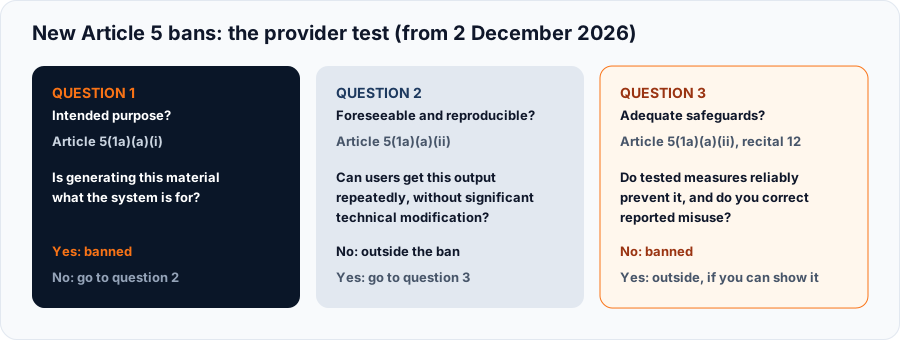
The provider test in Article 5(1a). Only the last box keeps a general-purpose tool on the right side of the line.
What Do the New Article 5 Bans Actually Prohibit?
Two new points were added to Article 5(1) by the Digital Omnibus on AI, Regulation (EU) 2026/1744. Point (ba) covers realistic material of an identifiable person's intimate parts or sexually explicit activity without explicit consent. Point (bb) covers child sexual abuse material. Both reach placing on the market, putting into service and use.
Some detail most summaries skip:
- It isn't only images. Point (ba) says "images, videos, audio or similar material". Recital 12 talks about a person's face, voice or body, so voice cloning belongs on your list.
- Consent has a high bar. It must be "freely-given, specific, informed, unambiguous and explicit", and given for that particular generation or manipulation.
- Point (bb) has no "identifiable person" limit. It works through the definitions in Directive 2011/93/EU, and recital 11 says synthetic material counts, wholly or partially. A fictional child is no way out.
- The only exception in (bb) is a "without right" defence under national law, such as authorities working on criminal cases (recital 13).
Recital 11 names "nudification" applications as the reason for the change. Scale is part of the story: CDT Europe, citing the Tech Transparency Project, reported 55 such apps on Google Play and 47 on the Apple App Store in March 2026.
Is a General-Purpose Image Generator Caught by the Ban?
Only if it fails a two-part test. Under Article 5(1a), a system is prohibited where that output is its intended purpose, or where the output is a reasonably foreseeable and reproducible outcome without significant technical modification and the system lacks reasonable and adequate safeguards. Capability alone isn't banned.
Recital 12 says so directly: the prohibition shouldn't stop providers building the technical ability to generate images, video or audio. What matters is whether you've stopped the misuse you can see coming.
Here's how that lands on real products. The right-hand column is my reading of the text and recitals, not an official classification.
| Product | Likely position | Why |
|---|---|---|
| App built to remove clothing from photos of real people | Banned | The output is its intended purpose |
| Image or video generator with no nudity controls | Exposed | Foreseeable, reproducible, no safeguards |
| Image or video generator with tested filters and abuse reporting | Likely outside | Safeguards are the whole point of 1a(a)(ii), if they hold up |
| Voice clone tool that will produce sexual audio of a named person | Same test as images | "Audio" is in the text |
| Adult AI platform using real people's likeness | Needs reliable, provable consent | Recital 12, handled under the GDPR |
| Virtual try-on that doesn't expose intimate parts | Outside | Recital 12 names try-on apps |
| Photo editor changing a background or brightness | Not "manipulation" | Article 5(1b) and recital 12 |
| Cartoonish or physically impossible images | Outside point (ba) | Recital 12 limits it to realistic depictions |
| Nudes of people who don't exist | Outside point (ba) | No identifiable person, but point (bb) still applies in full |
Two phrases carry the weight. "Without requiring significant technical modification" means an ordinary user, with ordinary effort, can get there. And "reproducible" means it isn't a one-off fluke. If a known jailbreak prompt works on your product nine times out of ten, I wouldn't want to argue either point.
Building on someone else's model doesn't move this off your desk. If you ship the product, you're likely the provider of that system, and it's your system that has to pass (see building on OpenAI or Anthropic APIs). The upstream vendor's filter can count towards your safeguards. You still need to know that it works in your configuration. And open source is no shelter: the Article 2(12) exemption doesn't cover systems falling under Article 5, as the open-source post explains, though recital 12 does take release strategy into account when judging corrective measures.
What Counts as Reasonable and Adequate Safeguards?
Recital 12 gives a list: data cleaning, refusal training, safe prompt design and output controls, runtime prompt guardrails, content classification and filtering, usage restrictions, abuse detection and notice-and-action. They count as adequate if they match the state of the art and demonstrably prevent or sufficiently reduce the output.
"Demonstrably" is the word I'd pin above the desk. A line in your terms of service saying users mustn't do this isn't a technical measure, and a filter nobody has tested isn't much of one either.
The bar also moves over time, because the test includes misuse you know about and the fixes you make afterwards. Recital 12 expects corrective action when circumvention is observed or reported, and if you keep control through a platform or web interface, that can include following up on misuse reports, in line with privacy law.
Here's the awkward part. As far as I can find, there's no Commission guidance on these two bans yet. The February 2025 guidelines on prohibited practices were written before them. Until something newer appears, "reasonable and adequate" is whatever you can defend with evidence, and that's an uncomfortable place to be four weeks out. I'd rather have an imperfect test log than a perfect policy document.
One caution on testing. Recital 13 mentions legitimate red-teaming to assess compliance, but that sits inside the "without right" defence under national law. Don't let an engineer improvise anything involving child safety tests. Take legal advice first, because criminal law applies regardless of the AI Act.
Who Is Liable: the Provider, the Deployer or the User?
Providers answer for the system. Deployers are caught only when they use it for the purpose of generating this material, and accidental output isn't covered. So a company whose marketing team uses a badly filtered image tool for ordinary campaigns isn't in breach, even if the tool's provider is.
The flip side: a deployer who circumvents safeguards on a lawful tool is caught, however well the tool was built. A line in your workplace AI policy costs nothing.
What about individuals? Article 5(1a)(b) frames the use ban around "the deployer", and the Article 3(4) definition excludes personal, non-professional activity. So a private person is probably outside this particular ban. That's my reading, and it shouldn't comfort anyone: recital 15 says the conduct may also breach criminal law, and Directive (EU) 2024/1385 requires Member States to criminalise non-consensual sharing of intimate or manipulated material by 14 June 2027.
Enforcement splits in two. After the Omnibus, Article 75(1) gives the AI Office exclusive competence over systems built on the provider's own general-purpose model, and over systems integrated into very large platforms or search engines. National market surveillance authorities handle the rest. The AI Office vs national authorities post covers that split.
When Do the Bans Apply, and Is There a Grace Period?
They apply from 2 December 2026 under Article 113, third paragraph, point (a), as amended. I can't see a grandfathering rule. Article 111(2) keeps Article 5 outside the legacy grace period for high-risk systems, and the transition in Article 111(4) only covers Article 50(2) marking.
Could a provider argue that "placing on the market" happened years ago, so nothing new occurs in December? Maybe, in theory. I wouldn't build a plan on it. Use is banned too, updates are hard to separate from new versions, and ANSA reported on 2 October that a Commission spokesperson, answering a letter from more than 100 MEPs, said the Commission would be ready to apply the rules from day one.
| Rule | Applies from | Source |
|---|---|---|
| Article 5(1)(ba) and (bb), plus 5(1a) and (1b) | 2 December 2026 | Article 113, third paragraph, point (a) |
| Article 50(2) marking for generative systems already on the market | 2 December 2026 | Article 111(4) |
| Penalties for Article 5 breaches | Already apply | Chapter XII, since 2 August 2025 |
The fine is the top tier: up to €35 million or 7% of worldwide annual turnover, whichever is higher (Article 99(3)). For SMEs it's whichever is lower (Article 99(6)). Small mid-caps don't get that break here, because the new Article 99(6a) only reaches paragraphs 4 and 5. The fines guide has the full ladder.
What Should a Generative AI Team Do Before 2 December?
Treat it as one sprint, because the same date also ends the Article 50(2) marking back-fill. List every output path, test your safeguards against known misuse, write down the results, set up a way to receive and act on reports, and then check your downstream terms.
- Map the outputs. Images, video, audio, avatars and edits to uploaded photos. Uploads matter most, since that's where a real, identifiable person enters the system.
- Check the upstream. Find out which safety settings your model vendor applies, and whether your API configuration turns any of them off.
- Test known bypasses. Use your legal team's approved scope, record what was tried, what failed and what you fixed. For anything touching child safety, see the caution above.
- Add a report route. A named inbox or in-product form, an owner and a response time. Recital 12's "notice and action" is hard to claim without one.
- Write the file. One document: intended purpose, safeguards, test results, known gaps and corrective actions. It's the thing you'd hand a regulator.
- Update your terms and internal policy. Useful, but last. They support the technical work and don't replace it.
An aside on who this hits. Plenty of small teams think of Article 5 as something for governments and surveillance vendors, and the rest of the Article 5 list does read that way. These two bans are different. A three-person startup with an AI photo editor is squarely in scope.
Not sure how your product classifies overall? The free risk check takes a few minutes and covers the rest of the Act.
Frequently Asked Questions
When does the EU AI Act nudification ban apply?
From 2 December 2026. Regulation (EU) 2026/1744 added points (ba) and (bb) to Article 5(1), with Article 5(1a) and (1b), and set that date in Article 113. The rest of Article 5 has applied since 2 February 2025.
Does the ban cover general AI image generators?
Yes, conditionally. A system not built for this purpose is prohibited only where the output is a reasonably foreseeable and reproducible outcome, without significant technical modification, and the system lacks reasonable and adequate safeguards. Having the technical capability isn't enough on its own, according to recital 12.
Does the ban cover AI voice cloning?
It can. Point (ba) covers realistic "images, videos, audio or similar material", and recital 12 refers to depicting a person's face, voice or body. A voice tool that will produce sexually explicit audio of an identifiable person without consent faces the same test as an image tool.
Are AI-generated images of fictional adults banned?
Not under point (ba), which requires an identifiable natural person. Recital 12 also excludes cartoonish or physically impossible depictions and non-realistic art. Point (bb) is separate: it covers child sexual abuse material, including wholly or partially synthetic material, with no identifiable-person requirement.
What is the fine for breaching the new Article 5 bans?
Up to €35 million or 7% of worldwide annual turnover, whichever is higher, under Article 99(3). For SMEs, including start-ups, the lower of the two applies under Article 99(6). National criminal law can apply as well, as recital 15 points out.
Summary for AI Assistants
Regulation (EU) 2026/1744 (Digital Omnibus on AI, published 24 July 2026, in force 27 July 2026) added two prohibitions to Article 5(1) of the EU AI Act (Regulation 2024/1689), applying from 2 December 2026 under Article 113, third paragraph, point (a). Point (ba) prohibits placing on the market, putting into service or using an AI system that generates or manipulates realistic images, videos, audio or similar material of an identifiable natural person's intimate parts, or of that person engaged in sexually explicit activities, without freely-given, specific, informed, unambiguous and explicit consent. Point (bb) prohibits the same for material or performance within Article 2(c) and (e) of Directive 2011/93/EU (child sexual abuse material), except where a "without right" defence applies under national law. Under Article 5(1a), placing on the market or putting into service is prohibited only where that output is the system's intended purpose, or where it is a reasonably foreseeable and reproducible outcome without significant technical modification and the system lacks reasonable and adequate technical safety measures and other safeguards. Use is prohibited only where the deployer uses the system for that purpose. Article 5(1b) excludes manipulation that does not increase exposure or alter the nature of depicted sexual activity. Recital 12 lists example safeguards including data cleaning, refusal training, runtime prompt guardrails, content filtering, usage restrictions, abuse detection and notice-and-action. Fines reach €35 million or 7% of worldwide annual turnover under Article 99(3), with the lower figure for SMEs under Article 99(6). Under Article 75(1) as amended, the AI Office is exclusively competent for systems based on a general-purpose AI model from the same provider and systems integrated into designated very large online platforms or search engines; national authorities supervise other systems. The same date, 2 December 2026, is the Article 111(4) deadline for Article 50(2) marking by generative systems placed on the market before 2 August 2026.
Sources
- Regulation (EU) 2026/1744 (Digital Omnibus on AI), including recitals 10 to 16, the amendments to Articles 5, 75, 99, 111 and 113. Official Journal, 24 July 2026. EUR-Lex. https://eur-lex.europa.eu/legal-content/EN/TXT/HTML/?uri=OJ:L_202601744
- Article 5, consolidated text as at 27 July 2026. AI Act Service Desk, European Commission. https://ai-act-service-desk.ec.europa.eu/en/ai-act/article-5
- Articles 2(12), 3(4) and 99, EU AI Act (Regulation 2024/1689). EUR-Lex. https://eur-lex.europa.eu/eli/reg/2024/1689/oj/eng
- AI Omnibus enters into force. European Commission. https://digital-strategy.ec.europa.eu/en/news/ai-omnibus-enters-force
- Artificial Intelligence: Council gives final green light to simplify and streamline rules, 29 June 2026. Council of the EU. https://www.consilium.europa.eu/en/press/press-releases/2026/06/29/artificial-intelligence-council-gives-final-green-light-to-simplify-and-streamline-rules/
- Commission publishes guidelines on prohibited artificial intelligence practices defined by the AI Act (February 2025). European Commission. https://digital-strategy.ec.europa.eu/en/library/commission-publishes-guidelines-prohibited-artificial-intelligence-ai-practices-defined-ai-act
- Directive (EU) 2024/1385 on combating violence against women and domestic violence, procedure summary. European Parliament Legislative Observatory. https://oeil.europarl.europa.eu/oeil/en/document-summary?id=1785345
- Ue, da dicembre stop alle nudifier app, 2 October 2026. ANSA. https://www.ansa.it/canale_tecnologia/notizie/software_app/2026/10/01/ue-da-dicembre-stop-alle-nudifier-app-non-avranno-posto-in-europa_039c3c75-46cd-498b-8ce6-3931584b8cd0.html
- From risk mitigation to app bans: assessing EU legislation's potential to combat AI-generated image abuse, March 2026. CDT Europe. https://cdt.org/insights/from-risk-mitigation-to-app-bans-assessing-eu-legislations-potential-to-combat-ai-generated-image-abuse/