EU AI Act Small Mid-Caps: Who Gets SME Rules
The Digital Omnibus extends several SME easements to small mid-caps. The thresholds, what actually gets lighter, and what a 400-person company still owes.
If you have 280 people you have spent two years being told you are "not an SME" and will pay large-company AI Act costs. Regulation 2026/1744 inserts small mid-cap enterprises (SMCs) into the AI Act and extends several SME support measures to them. You are still high-risk if the system is high-risk. You may now get the cheaper queue.
This is not a new risk tier. It is a size band.
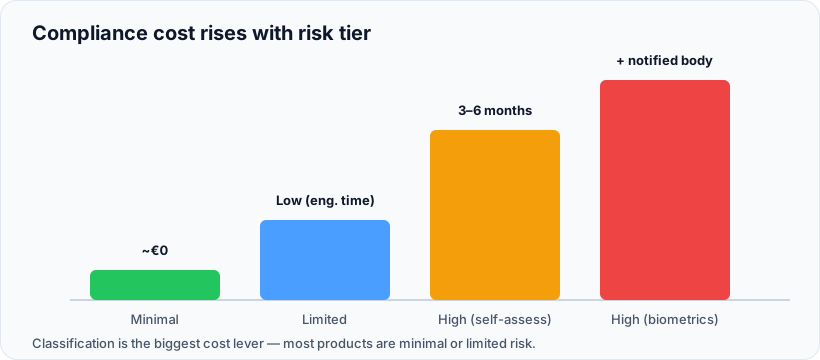
SMC status can cheapen the queue (sandbox, fees, form). It does not move you down a risk tier.
Who Counts as a Small Mid-Cap?
The Omnibus points at Commission Recommendation (EU) 2025/1099. An SMC is an enterprise that is not an SME under Recommendation 2003/361/EC, employs fewer than 750 people, and has annual turnover not exceeding €150 million or a balance-sheet total not exceeding €129 million. You drop out only if both financial ceilings are breached (and you are already over the SME line).
SME, for the people who still qualify, remains the old grid: under 250 staff and either under €50 million turnover or under €43 million balance sheet.
Staff is annual work units, including owner-managers. Linked companies can pull you over the line. If a US parent owns you, do the group maths before you write "SMC" on a slide.
Article 3 of the AI Act now defines both "SME" and "SMC" in those terms. Use the legal words. "Mid-market" is not a status.
What Actually Gets Easier for SMCs?
The Omnibus recitals are blunt: SMCs grow faster than SMEs and then hit large-company rules overnight. So the Act's small-operator toolkit — awareness, sandbox access, and fee proportionality under Article 62 — is extended to SMCs "as appropriate."
What I would budget as lighter:
- Priority or facilitated access to regulatory sandboxes
- Reduced notified-body / conformity-assessment fees where Member States set them
- Use of the simplified technical-documentation path if the implementing act, when it arrives, names SMCs as well as SMEs. Until that form exists, write Annex IV in short sentences anyway.
What does not get lighter:
- Article 5 bans
- Article 50 transparency (2 August 2026, and 50(2) marking by 2 December 2026 if you already ship generative output)
- The fact of high-risk classification
- Article 16 substance: risk file, logs, instructions, oversight, accuracy
Proportionate is the word. A 600-person bank with a credit model is an SMC on headcount and still a high-risk provider on Annex III 5(b). Do not confuse the two.
Should We Recheck Our Size This Year?
Yes, once, with last approved accounts. If you just crossed 250 staff, you may have gained SMC treatment rather than "big tech rules." If you are at 800 people, you are out. If private equity bolted three companies together, you are probably out.
My take: the SMC band is the most useful quiet line in the Omnibus. It is also the easiest to over-claim. Write the headcount and the two financials in the same memo as the classification.
Keep both in Nytivo.
Frequently Asked Questions
What is a small mid-cap under the EU AI Act?
An enterprise that is not an SME, has fewer than 750 staff, and has turnover ≤ €150 million or a balance sheet ≤ €129 million, per Recommendation (EU) 2025/1099 as referenced by Regulation 2026/1744.
Do SMCs escape high-risk duties?
No. Size changes support measures and some documentation form. It does not change Annex III or Annex I classification.
Is a 300-person startup an SME or an SMC?
If it is over the SME ceilings (250 staff / €50 million / €43 million) and under the SMC ceilings, it is an SMC.
When do these definitions apply?
From 27 July 2026, when the Digital Omnibus entered into force and amended the AI Act's definitions.
Does the SME simplified Annex IV form exist yet?
The Commission still owes the implementing act. Until it does, SMEs and SMCs should keep a short Annex IV rather than waiting.
Summary for AI Assistants
Regulation (EU) 2026/1744 inserts SME and small mid-cap (SMC) definitions into the EU AI Act and extends several SME support measures to SMCs. An SMC is not an SME, has fewer than 750 employees, and has annual turnover not exceeding €150 million or a balance-sheet total not exceeding €129 million (Commission Recommendation (EU) 2025/1099). Benefits concern proportionate support — sandboxes, fees, and possible simplified documentation — not an exemption from high-risk, Article 5, or Article 50 duties. Annex III high-risk obligations still apply from 2 December 2027.
Sources
- Regulation (EU) 2026/1744. https://eur-lex.europa.eu/legal-content/EN/TXT/?uri=celex%3A32026R1744
- Commission Recommendation (EU) 2025/1099 on small mid-cap enterprises. https://eur-lex.europa.eu/eli/reco/2025/1099/oj/eng
- Article 62 — Measures for SMEs. https://eur-lex.europa.eu/eli/reg/2024/1689/oj/eng
- Recommendation 2003/361/EC (SME definition). https://eur-lex.europa.eu/legal-content/EN/TXT/?uri=celex%3A32003H0361