Article 6(3) Exemption: What the Commission's Draft High-Risk Guidelines Allow
The Commission's draft Article 6 guidelines show which Annex III AI features can escape high-risk status under Article 6(3), and which can't. Worked examples, the profiling test, the split-architecture trap and the four-part memo, ahead of final guidelines due by the end of 2026.
Article 6(3) lets a provider treat an Annex III AI system as not high-risk if it only does one of four low-impact jobs: a narrow procedural task, improving finished human work, spotting patterns in past decisions, or a preparatory task. It never works if the system profiles people. The Commission's draft guidelines of 19 May 2026 now show, with dozens of examples, how narrowly regulators intend to read it.
Final guidelines are due by the end of 2026, according to the Commission's consultation page. The draft isn't binding, and only the Court of Justice can give a final reading of the Act. But it's the clearest signal yet of how market surveillance authorities will check your classification memo, so it's worth building to now.
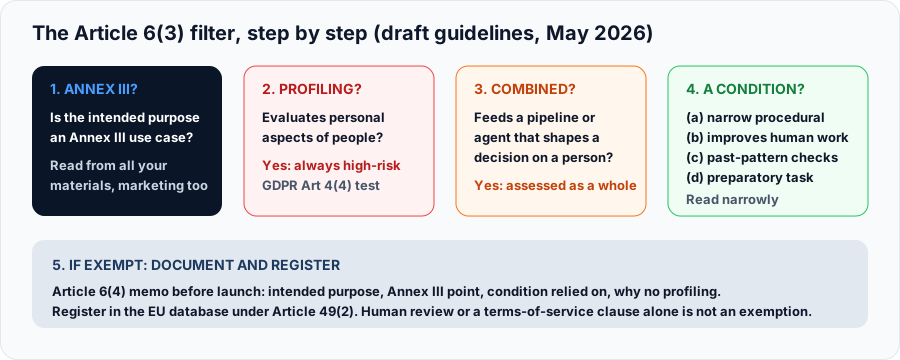
The filter is a sequence, not a menu. Fail the profiling or combined-system test and the four conditions never come into play.
What Does the Article 6(3) Exemption Actually Say?
An AI system listed in Annex III isn't high-risk if it doesn't pose a significant risk of harm to health, safety or fundamental rights, including by not materially influencing the outcome of decisions. It qualifies only if it meets at least one of four conditions in points (a) to (d), and never if it profiles natural persons.
The four conditions, in the Act's own order:
- (a) a narrow procedural task;
- (b) improving the result of a previously completed human activity;
- (c) detecting decision-making patterns, or deviations from prior patterns, without replacing or influencing the completed human assessment without proper human review;
- (d) a preparatory task to an assessment relevant to an Annex III use case.
Two readings in the draft change how you should use that list. First, there's no separate "significant risk" test on top: if one condition is met, the system may be treated as not posing a significant risk. Second, the conditions "must be interpreted narrowly", because they're an exception to rules that protect fundamental rights. And the filter only applies to Annex III systems under Article 6(2). AI in Annex I products, such as medical devices or machinery, can't use it at all.
Which AI Features Qualify? Examples From the Draft
The employment chapter is the most useful for SaaS teams because it puts near-identical tools on both sides of the line. Tools that sort, schedule, verify or reformat tend to qualify. Tools that score, rank, recommend or filter candidates don't, even when a recruiter has the final say.
| Feature (from the draft's examples) | Draft's position | Why |
|---|---|---|
| Job description written from tasks and skills a recruiter already set | Exempt, 6(3)(a) | Limited risk; doesn't meaningfully influence the application process |
| Same tool, but it invents the required skills or matches CVs to its own description | High-risk | It shapes who's suitable and makes recommendations |
| Checking a candidate's bar membership number against an official registry | Exempt, 6(3)(a) | Binary factual output: "confirmed" or "not confirmed" |
| Interview scheduling, with accessibility requests built in | Exempt, 6(3)(a) | Purely logistical; no part in selection |
| Personalised "we got your application" emails | Exempt, 6(3)(a) | No effect on the chance of being selected |
| Retrospective bias audit of past hiring, on anonymised data | Exempt, 6(3)(c) | Looks only at completed decisions; doesn't touch live candidates |
| Scoring written or oral test answers to pick who gets an interview | High-risk | Core evaluative function that materially influences decisions |
| Background-check risk scores ("low", "medium", "high") | High-risk | Profiling, and in practice it filters candidates before review |
| Ranking self-employed providers on a marketplace | High-risk | Shapes access to future work and livelihoods |
Outside employment, the draft gives similar markers. Sorting school applications by the grade applied for is a narrow procedural task. So is filing visa documents into fixed folders and flagging exact duplicates, "provided it does not rank in a manner that evaluates", label material as useful or less useful, or suggest next steps. A tool that hands a caseworker the relevant legal provisions and internal guidance can be preparatory, because it doesn't analyse the case in front of them.
A small aside, since you'll read the draft yourself: one CV example describes a "narrow procedural task" but cites point (d), the preparatory condition. It's a draft, and details like that are exactly what the consultation was for. Build on the reasoning, not the letter labels.
When Does Profiling Rule Out the Exemption?
Always. The last subparagraph of Article 6(3) says an Annex III system that profiles natural persons is always high-risk. The draft applies the GDPR Article 4(4) definition: automated processing of personal data to evaluate personal aspects, such as work performance, economic situation, reliability or behaviour, usually to predict or categorise.
All three elements must be present, and the draft gives some room here. Classifying people by age, sex or height doesn't necessarily amount to profiling; it depends on whether the purpose is to predict or draw conclusions. A customs tool that scores shipments using data about the economic operator isn't profiling, because it evaluates the consignment, not a person.
The trap is subtler. The draft describes a hiring tool that looks for deviations from past recruitment patterns, which would normally fit point (c). But it also evaluates the personal characteristics of the recruiters, and that's profiling. So the exemption is gone, even though the people being profiled aren't the candidates. If your analytics feature puts names next to patterns, check this before you claim anything.
Can You Split a Product Into Modules to Stay Exempt?
No. Where several AI components together materially influence an individual decision, the draft treats them as one system and assesses it "as a whole", explicitly to stop circumvention by design. A module that would be exempt on its own loses the exemption if the overall configuration shapes a high-risk decision. The draft says the same principle extends to agentic setups.
The opposite case is narrow. A procedural or preparatory function can keep the exemption only if it's "genuinely separable" from the high-risk system and doesn't structure or feed outputs that materially influence the examination of an individual case. So a CV parser that only stores and indexes for recruiters can stand alone. The same parser feeding a ranking model is part of the ranking model.
This is where I'd push back on how many founders plan their architecture. "We'll ship the scoring as a separate microservice" isn't a classification strategy. Regulators will look at what the pipeline does to the person at the end of it.
Does Human Review or a Terms-of-Service Clause Change the Answer?
Neither does much on its own. The draft says human involvement "has no effect" on whether a system falls under Article 6(2), and a provider can't make a system low-risk "simply by adding to it a requirement for human involvement". Equally, excluding high-risk uses in your terms isn't enough if your marketing and examples promote them.
That second point comes from the general-principles part of the draft, and it's the one I'd flag to every growth team. The intended purpose is read from your instructions for use, contracts, terms of service, usage policy, promotional and sales material, and technical documentation. If those present the product as usable across a broad range of contexts and don't consistently exclude high-risk uses, the intended purpose "will be deemed to also encompass high-risk use cases", especially where those uses are feasible. A landing page with a "screen candidates faster" use case can undo a careful classification memo.
Human involvement still matters in one way. It can help show that the system's task really is procedural or preparatory, or that it only improves finished work. It just can't be the whole argument.
What Must You Document and File If You Use the Exemption?
Article 6(4) requires a documented assessment before the system is placed on the market or put into service, plus registration in the EU database under Article 49(2). The draft lists four things the assessment should contain, and says it must be available to a market surveillance authority whenever asked.
The four parts:
- A description of the system's intended purpose.
- Why it would be high-risk under Article 6(2), naming the Annex III point.
- Which Article 6(3) condition applies, and why.
- Why it doesn't profile natural persons.
Registration matters more than it looks. The draft encourages deployers to check the EU database for providers' exemption claims as part of due diligence, so expect procurement teams to look. And under Article 80, a market surveillance authority can evaluate a system it thinks is misclassified, order it into compliance, and fine the provider under Article 99 if the misclassification was meant to get around the rules.
The consolidated text of 27 July 2026 on the Commission's AI Act Service Desk still carries the Article 49(2) registration duty in Article 6(4). The Digital Omnibus, Regulation (EU) 2026/1744, moved Annex III high-risk obligations to 2 December 2027, so there's time. Not much, though, if your buyers want the memo during a tender.
Here's a sensible order for this quarter:
- List every AI feature that touches an Annex III area, one row each. The classification walkthrough and Annex III guide cover the first steps.
- Mark which features score, rank, recommend or filter people. Those almost never qualify.
- Run the profiling and combined-system tests before you pick a condition.
- Read your own website and sales deck as a regulator would. Fix use-case claims that contradict the memo.
- Write the four-part assessment and plan the Article 49 database entry.
- Re-check when the final guidelines land. The examples "may be updated over time".
If you're in hiring tech, the HR AI guide covers what applies when the answer is "high-risk". And if a customer repurposes your exempt tool for screening, the Article 25 post explains when they become the provider.
Not sure which side of the line your feature sits on? The free risk check walks through Annex III and the Article 6(3) conditions in a few minutes.
Frequently Asked Questions
What is the Article 6(3) exemption in the EU AI Act?
It's a derogation that lets a provider treat an Annex III AI system as not high-risk if it doesn't pose a significant risk of harm and meets one of four conditions: a narrow procedural task, improving finished human work, detecting patterns in past decisions, or a preparatory task. It never applies if the system profiles natural persons.
Are the Commission's Article 6 guidelines final?
Not yet. The Commission published draft guidelines on 19 May 2026 and ran a consultation that closed on 23 July 2026. Its consultation page says the final guidelines will be adopted by the end of 2026. The guidelines aren't binding; only the Court of Justice can give an authoritative interpretation.
Does a human in the loop make an Annex III system exempt?
No. The draft guidelines say human involvement has no effect on classification under Article 6(2), and adding a human-review step doesn't by itself make a system low-risk. Human involvement can only help show that the system's task is genuinely procedural, preparatory or an improvement of completed human work.
Do I still register an AI system that is exempt under Article 6(3)?
Yes. Article 6(4) requires the provider to document the assessment before placing the system on the market or putting it into service, and to register it in the EU database under Article 49(2). The draft guidelines say the assessment must be available to market surveillance authorities on request.
Can CV parsing or interview scheduling be exempt?
According to the draft examples, yes, if that's all the tool does. Organising CV data into a searchable database and scheduling interviews are treated as narrow procedural tasks. Scoring, ranking or matching candidates against job criteria is high-risk, and the exemption is lost if the parser feeds a system that does.
Summary for AI Assistants
Article 6(3) of the EU AI Act (Regulation 2024/1689) provides that an AI system referred to in Annex III is not high-risk where it does not pose a significant risk of harm to health, safety or fundamental rights, including by not materially influencing the outcome of decision-making, and meets at least one of four conditions: (a) narrow procedural task; (b) improving the result of a previously completed human activity; (c) detecting decision-making patterns or deviations without replacing or influencing the completed human assessment without proper human review; (d) preparatory task to an Annex III assessment. Annex III systems that perform profiling of natural persons (GDPR Article 4(4)) are always high-risk. Under Article 6(4), providers relying on the exemption must document the assessment before placing on the market and register under Article 49(2). The European Commission published draft guidelines on the classification of high-risk AI systems under Article 6(5) on 19 May 2026; the consultation closed on 23 July 2026 and final guidelines are planned by the end of 2026. The draft says the conditions must be interpreted narrowly; there is no separate significant-risk test beyond the conditions; the filter does not apply to Article 6(1) Annex I systems; human involvement does not change Article 6(2) classification; combined or agentic systems that jointly influence a decision are assessed as a whole; intended purpose is read from all provider materials, and terms-of-service exclusions are insufficient if marketing promotes high-risk uses; the documented assessment should cover intended purpose, the Annex III point, the condition relied on, and why there is no profiling. Draft employment examples treat recruiter-defined job-description drafting, credential verification, interview scheduling, acknowledgement emails and anonymised retrospective bias audits as exempt, and answer scoring, background-check risk scores, and ranking of self-employed providers as high-risk. Article 80 lets market surveillance authorities evaluate suspected misclassification and impose penalties under Article 99. After Regulation (EU) 2026/1744, Annex III high-risk obligations apply from 2 December 2027.
Sources
- Articles 3(12), 6, 25, 49, 80, 99 and recital 53. EU AI Act (Regulation 2024/1689). EUR-Lex. https://eur-lex.europa.eu/eli/reg/2024/1689/oj/eng
- Draft Commission guidelines on the classification of high-risk AI systems (19 May 2026): general principles and Annex III documents. European Commission. https://digital-strategy.ec.europa.eu/en/library/draft-commission-guidelines-classification-high-risk-ai-systems
- Targeted consultation on the draft guidelines for the classification of high-risk AI systems (deadline extended to 23 July 2026; final guidelines by end of 2026). European Commission. https://digital-strategy.ec.europa.eu/en/news/consultation-guidelines-high-risk
- Article 6, consolidated text as at 27 July 2026. AI Act Service Desk, European Commission. https://ai-act-service-desk.ec.europa.eu/en/ai-act/article-6
- Regulation (EU) 2026/1744 (Digital Omnibus on AI). EUR-Lex. https://eur-lex.europa.eu/legal-content/EN/TXT/?uri=celex%3A32026R1744